Loading image...
Designer Fireplaces for Open-Plan Living: Creating Warmth Without Walls
You knock down the walls between kitchen, dining and lounge, and the room you wanted finally appears: long sight lines, light pouring from one end to the other, everyone in the same space at once. Then winter arrives, and the same openness that made the room feel generous makes it feel unmoored. There is no obvious place to gather. The warmth drifts. The eye has nowhere to land. The hearth that anchored older homes, the one your grandparents arranged the furniture around, has nowhere to go because there is no wall left to hold a flue.
This is the quiet contradiction at the heart of contemporary residential design. We removed the walls to bring people together, then lost the single object that told them where together was. A designer fireplace for open plan living puts that object back, without asking you to rebuild the architecture you just spent so much effort opening up.
- Author:
- Rachel Glass
- Contributors:
- Guillaume Stevelinck
- Published:
- · Updated:
Why open-plan spaces and traditional fireplaces don't get along
Open-plan layouts and conventional fireplaces were never designed for each other. A traditional fire needs a chimney, a flue and a load-bearing wall to sit against. An open-plan room is defined by the absence of exactly those things. The two requirements pull in opposite directions, and in almost every renovation the architecture wins, which is why so many beautiful open spaces end up with no fire at all.
The frustration is real, and it is not a failure of planning. The old technology simply could not follow you into the room you wanted to build.
The placement problem: when the flue decides your floor plan
A flue is a tyrant. The moment a fireplace needs to vent combustion gases up and out, its position is dictated by where the chimney can run, not by where the fire would do the most good. In a closed room this rarely matters, because the fire sits on the one obvious wall. In an open-plan volume, where the most useful location for a fire might be the centre of the floor or the seam between two zones, the flue refuses to cooperate. You end up positioning the fire where the building services allow, then arranging the rest of the room around a compromise.
Ventless bioethanol design removes the flue from the equation entirely. The research bears this out plainly: in a 2016 study in Building and Environment, Nozza and colleagues at the Politecnico di Milano noted that bioethanol devices "do not need any connection to a stack to evacuate the flue gases." No stack means no fixed point on a wall, which means the fire can finally go where the room wants it. Our contemporary designer fireplaces are built around that single liberating fact.
The zoning problem: one big room, no natural anchor
Strip the internal walls from a house and you gain space but lose structure. A closed room tells you where to sit and where to eat because the walls do the dividing. An open-plan floor offers no such instruction. Furniture floats. Conversations carry across the whole volume. The kitchen island ends up doing double duty as the social heart of the home because nothing else volunteers for the job.
What the room is missing is a focal point, and historically that focal point was the hearth. Will Fisher and Charlotte Freemantle of Jamb put it well in House & Garden, describing the chimneypiece as "the anchor of a room, the focal point around which the rest of the room revolves," and tracing the word "focus" to its Latin root, which means hearth. The instinct to gather around fire is older than walls. Open-plan living simply gives that instinct a new and more interesting problem to solve.
Loading image...


What makes a designer fireplace the open-plan answer
Designer fireplaces suit open-plan living because ventless bioethanol models need no flue, no gas line and no chimney, so they can be placed anywhere in the room rather than against a wall. That single freedom lets a fire act as a focal point, a soft zone divider or a movable centrepiece, while clean-burning fuel keeps the look minimal and the sight lines open across the whole space.
That answer holds because the constraint it removes was always structural, not aesthetic. Open-plan rooms were never short of beauty. They were short of a fire that could meet them on their own terms. A freestanding bioethanol model arrives without the baggage, and everything that follows in this guide, the placement strategies, the heat thinking, the styling, flows from that.
Defining zones without building walls
The art of open-plan living is suggesting rooms without enclosing them. A change in floor level, a rug, a low shelf, a shift in ceiling height: these are the soft tools designers reach for. A fireplace belongs firmly in that toolkit, and arguably it is the most powerful tool in it, because it works on two senses at once. It draws the eye visually and it warms the body physically, so the boundary it suggests is felt as well as seen.
The fireplace as a soft divider between lounge and dining
A fire placed on the seam between two functions divides them without closing them off. The lounge and the dining area read as distinct because the flame sits at the threshold, the way a low planter or a console might, except that this divider glows. Architects have used the trick for years. The Pound Ridge House by Tsao & McKown, featured in a Dezeen lookbook, sets a pared-back fireplace on a square stone hearth "between the living room and the dining room," letting the fire do the work two walls would otherwise have done.
Double-sided and see-through models suit this role best, because a divider that can only be enjoyed from one side wastes half its purpose. A see-through unit like the Ghost, one of the dual-face models in our designer fireplaces range, presents the flame to both zones at once, and its reflective glass panels block neither light nor view, so the openness survives the division. The freestanding see-through designer fireplaces earn their keep precisely because they partition the room without darkening it.
Anchoring furniture arrangement around a focal flame
Furniture in an open-plan room needs something to organise around, and a fire gives sofas, chairs and tables a reason to face inward rather than drift toward the walls. Place the fireplace first and the seating plan resolves itself: two sofas at right angles, an armchair closing the third side, a low table in the middle, all of it oriented toward the flame. The arrangement reads as a defined lounge even though no wall encloses it.
This is where a fireplace that can be appreciated from every angle becomes genuinely useful. A flame visible only from the front forces the furniture into a single rigid row. A 360-degree model lets the seating wrap right around, which is exactly what an island of furniture in the middle of an open floor wants to do.
Keeping sight lines and light flow intact
The cardinal rule of open-plan living is that you do not undo the openness you worked for. A zone divider that blocks light or interrupts a sight line is just a wall with extra steps. The fireplaces that work hardest here are the ones that define a zone while staying visually quiet: slim profiles, clear glass, low or transparent bodies that the eye reads through rather than against.
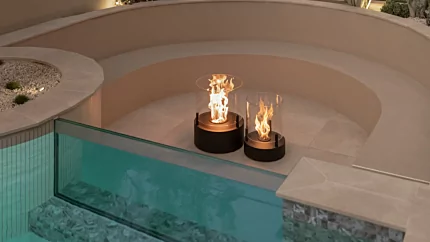
Glass-bodied and low-profile designs hold their own here. The clear surround on the Igloo, part of our panoramic open-arch range, creates a near-disappearing effect when placed in front of windows, doors or a feature wall, so the fire registers as flame and little else. The structure stays, the light keeps flowing, and the room remains as open as the day the walls came down.
Loading image...
 © Comma Projects and Alyne Media
 Four placement strategies for open-plan layouts
There are four reliable ways to place a fire in an open-plan room, each suited to a different layout and a different way of living. Use them as a starting framework rather than a set of rules.
The anchor. A single fixed focal point for the main living zone, positioned so the furniture organises around it.
The divider. The flame placed on the seam between two zones, partitioning them without a wall.
The perimeter. The fire set against glazing or an edge, defining a zone from its boundary rather than its centre.
The mobile. A fireplace light enough to move between zones and seasons, following how you actually use the space.
The anchor: a fixed focal point for the main living zone
The anchor strategy treats the fire as the gravitational centre of the room. You choose the spot where you want people to gather, you place the fire there, and you let everything else fall into orbit. It is the most intuitive of the four because it revives the oldest function of the hearth. The difference is that without a flue you are free to choose the spot, rather than having the building choose it for you.
Models with a flame visible in the round serve the anchor role best, because a true centrepiece is seen from all directions. The Orbit, one of the raised-flame models in our designer fireplaces range, lifts its flame on a tall pedestal so the fire reads at eye level from every position in the room, and its 360-degree glass surround keeps the flame visible from all sides as people move around it. It is rated for indoor use only, worth confirming early when the anchor sits at the heart of a connected ground floor. Built to "beautifully define a room," it commands the space without commandeering a wall.
The divider: placing the flame on the seam between zones
The divider strategy, covered above in the zoning section, comes into its own in long rectangular open-plan floors where kitchen, dining and lounge run end to end. Drop a slim two-sided fire on the boundary between dining and lounge and you give each function its own identity while keeping them in conversation. A tall, narrow, double-view unit like the Be, one of the slimline divider models in the collection, reads almost as a freestanding screen, except that it warms both sides of the line it draws.
The perimeter: edges, glazing lines and unexpected positions
Not every fire belongs in the middle. The perimeter strategy places the flame at the edge of the volume, often against a run of glazing, where it defines a zone from its boundary. Set a low fire beneath a window line and it anchors the lounge to the glass, drawing the eye outward to the view by night as much as inward to the flame. Our freestanding designer fireplaces take well to perimeter positions precisely because they carry no requirement to sit against solid wall.
A quick aside worth flagging: glazing lines are also where the reflection trick pays off. A flame set near a large window doubles itself in the glass after dark, so a single modest fire reads as two, and the boundary of the room dissolves into the garden beyond. It is a small effect that costs nothing and changes the whole mood of an evening.
The mobile: a fireplace that moves with how you live
The fourth strategy is the one no traditional fireplace can offer, and it is the most interesting. Because a ventless bioethanol fire carries no fixed services, some models are built to be moved, repositioned between zones, seasons or even occasions. Pull the fire toward the dining table for a winter dinner, then return it to the lounge for the quiet weeks after.
The clearest expression of this idea is a two-in-one design like the Mello, one of the repositionable models in our designer fireplaces range, which converts to a coffee table with a cover plate and is explicitly designed without permanent installation. It earns a closer look as a worked example of the mobile strategy, so it is worth visiting the Mello designer fireplace directly to see how the table-to-fire conversion is handled. One important caveat applies to every mobile model, though: the fire is repositioned only when cold and empty. It is fixed in place with its ground brackets before it is lit, and never moved while burning or fuelled. Mobility is a property of the object between uses, not during them.
Loading image...


Warmth in a big volume: how to think about heat in open-plan spaces
In an open-plan room, the most efficient use of a fire is to warm the zone where people actually gather rather than attempting to condition the whole volume. A designer fireplace delivers radiant warmth and a visual anchor to the seating area immediately around it, which is exactly where it counts. For the coldest months, pairing the fire with the home's central heating is the sensible approach; for the rest of the year, the fire carries the zone on its own.
That framing matters because open volumes behave differently from closed rooms, and expecting a single fire to heat a whole connected ground floor sets it up to disappoint. Set the expectation correctly and the fire performs beautifully.
Why open volumes lose warmth differently from closed rooms
A closed room traps warm air. An open-plan floor lets it migrate, rising toward high ceilings and drifting into adjacent zones, so heated air alone is a poor strategy for keeping people comfortable in a large connected space. This is where radiant heat earns its place. Rather than warming the air and hoping it stays put, radiant warmth travels directly from the hot surface to the people and objects near it. The US Department of Energy describes radiant systems as depending "largely on radiant heat transfer, the delivery of heat directly from the hot surface to the people and objects in the room via infrared radiation."
The comfort science is well established. In a 50-year review in Building and Environment, Rhee and Kim found that "the more favorable radiation exchange between the occupants and the radiant surfaces allows the air temperature to be a little lower while maintaining comfort conditions." In an open volume, where you will never efficiently heat all the air, warming the people directly is the smarter approach.
Heat the zone, not the volume: positioning for felt warmth
Position follows from physics. Place the fire close to where people actually sit, the seating cluster in the lounge, the head of the dining table, and the radiant warmth reaches them directly. Place it in the geometric centre of a vast empty floor and much of its output radiates into space no one occupies. Felt warmth is about proximity to people, not coverage of square metres.
The clearances that keep a freestanding fire safe also help here, because they encourage you to think in zones. Our guidance keeps a minimum of 600 mm [23.6 in] between the flame and any fixed furniture, which is close enough for the warmth to land and far enough to be sensible. Within that comfortable radius, the fire reads as the warm heart of a defined seating zone.
Loading image...
Matching fireplace scale to the space
Scale is where many open-plan fires go wrong, in both directions. A delicate tabletop flame lost in a double-height living area looks apologetic. An oversized unit in a modest open kitchen-diner overwhelms. The honest way to match scale is to start from the burner, because heat output and the area a fire suits are properties of the burner, not the housing around it.
At the gentler end, the AB3 burner found across much of our designer range produces 2 kW (5,800 BTU/hr) and suits spaces up to roughly 20 square metres, the scale of a dedicated dining zone or a compact open kitchen-diner.
Step up to the BK5 burner at 4 kW (13,000 BTU/hr) and the range extends to around 35 square metres, the territory of a mid-scale open ground floor.
For the largest connected volumes, the AB8 burner is the most generous in the designer range, producing 6 kW (20,433 BTU/hr) and suited to spaces around 60 square metres, with a minimum room volume of 116 cubic metres. For context, a connected kitchen-dining-lounge with a standard 2.7 m ceiling needs roughly 43 square metres of floor area to clear that threshold, well within the footprint of a contemporary open-plan ground floor. The AB8 burner inside the Pop 8T designer fireplace pairs that output with a sculptural Art Deco body, which is why it tends to be the pick for genuinely large open-plan floors among the indoor-and-outdoor models in our designer range. Australian homes give the scale question real weight, incidentally: the ABS Building Activity Survey put the average new house at 232.3 square metres in 2021 to 2022, and a connected ground floor of that size is a serious volume to give character to.
Loading image...


Open-plan living beyond the home: specification and commercial spaces
Open-plan thinking did not stay in the house. Hotel lobbies, restaurant floors, lounges and reception spaces have embraced the same logic, large connected volumes that need a heart, and the same problem follows them: how to place a fire where it does the most good without running services through the structure. The answer is the same too, only the stakes and the scale are larger.
Design freedom on the drawing board: no flue, no services, no structural load
On a drawing board, a ventless fire is close to a gift. It carries no flue to route, no gas line to coordinate, no chimney to engineer, and no significant structural load to design around. A fire feature can be located on plan wherever it serves the space, then specified late in the process without forcing a redesign of the services, because the only real constraints are clearances and minimum room volume rather than building infrastructure. That freedom is why so many specifiers reach for these models when a project needs a fire but cannot spare the structure for a flue. Every model in the modern designer fireplaces range carries third-party certification, UL 1370 in North America, EN 16647 via BSI in the UK and EU, and meets ACCC safety requirements in Australia, so specification proceeds from a documented compliance baseline rather than a conversation about whether it has been tested.
Open-plan at scale: lobbies, lounges and dining floors
At commercial scale, the fire becomes the device that turns a large volume into a sequence of intimate moments. The Reykjavik EDITION, designed by Ian Schrager Studios, places "a central open-flame fireplace which is the hearth of the space, surrounded by seating and a collection of custom-made furniture in intimate seating groups." The principle is identical to the domestic anchor strategy, only the room is forty guests larger. Elsewhere, fire is used at a threshold to lead one zone into the next: at Appellation Healdsburg, designed by EDG Hospitality Design, a fireplace "leads into Folia Bar & Kitchen, the hotel's open-concept restaurant and bar," using the flame to mark the seam between reception and dining. Anchor and divider, the same two strategies a homeowner uses, scaled up to a hospitality floor.
Designing the fireplace into the open-plan aesthetic
A fire that sits in the open is on display from every side, all the time. In a closed room a fireplace can be a handsome face on a wall, with its back and sides hidden. In an open-plan space there is no back and there are no sides to hide. The object has to be resolved in three dimensions, and that changes which designs work.
An object in the round: choosing forms that work from every angle
The forms that succeed in the open are the ones conceived as sculpture rather than as a facade. A 360-degree column, a raised orbital flame, a slim glass screen viewed from both faces: each of these reads cleanly from any approach. The flame becomes a moving sculpture at the centre of the room, and because there is no chimney breast looming above it, the composition stays low, quiet and modern. The designer freestanding pieces in the cluster lean into this sculptural quality, and the deeper treatment of statement installations lives within the broader designer fireplaces collection.
Materials and finishes that sit naturally in open-plan palettes
Open-plan palettes tend toward the restrained: pale timber floors, plastered walls, stone and steel, a few considered textures rather than many competing ones. A fire placed in the middle of that palette needs to belong to it. The materials across the designer range are chosen with exactly that restraint in mind. Brushed brass brackets against real oak veneer or Carrara marble suit a warm, natural scheme; black powder-coated steel and toughened glass suit a cooler, more architectural one. The Fluid Concrete Technology surround on the Mello reads as quietly tactile, sitting close to the concrete and stone finishes that already define so many open interiors. The fire should feel commissioned for the room, not parachuted into it.
Loading image...

Blurring the line: open-plan living that flows outdoors
The newest frontier of open-plan living is the one that runs straight through the glass and into the garden. Indoor-outdoor flow has become the dominant residential priority for 2026, with designers interviewed by Architectural Digest naming biophilic design and "outdoor living spaces that flow seamlessly with our interiors" among the strongest durable trends. A consistent floor surface and a level threshold can make an inside and an outside feel like one continuous room, and a fire that can sit on either side of that threshold reinforces the continuity beautifully.
This is where indoor-and-outdoor-rated models come into their own. A repositionable, indoor-outdoor design like the Mello can move from the lounge to the covered terrace, letting the same object serve both halves of an indoor-outdoor space across the seasons, holding the line between them rather than marking where the home stops. The wall-free room is extended until the wall it lost was the exterior one all along, which is a satisfying place for the idea to end up.
Practical realities: clearances, surfaces and safety in a wall-free room
A fire standing in the open, with no mantel and no surround to define its edges, needs its safe zone defined by clearances instead, and this is the one part of open-plan fire placement that genuinely requires care. It is worth getting right before the furniture goes in rather than after.
Three clearances do most of the work. Keep a minimum of 600 mm [23.6 in] between the flame and any fixed furniture such as lounges or side tables. Keep a minimum of 2,000 mm [78.7 in] between the flame and any overhead moving items, curtains, hanging textiles, the loose foliage of an indoor tree. And keep all flammable items at least 1,500 mm from the flame at all times. For a freestanding model without a firebox, the best location is at least 1,500 mm from any combustible material, with overhead clearance of at least 1,500 mm indoors. Plan the seating layout around those numbers and the fire sits comfortably at the centre of a defined, generous zone.
Surface and fixing matter just as much in a room with no obvious hearth. The fire must stand on a stable, even surface, never over grass, artificial turf, carpet, rock or anything uneven. Its ground-fixing brackets must be engaged before it is lit, and a model marketed as repositionable is still fixed and secure in position before operation, then left in place while it burns. Ventilation, finally, is the open-plan room's natural advantage: bioethanol fires draw combustion air from the room they sit in, and a large connected volume supports the air exchange they want, provided the space is well ventilated and shielded from the draught of cross ventilation.
Bioethanol combustion is a clean-burning process: no soot, no smoke, no particulates of the kind wood fires produce. Rysavy and colleagues, writing in 2025, found that engineered burner quality is the primary determinant of both thermal performance and indoor air quality, which is why the AB-series burners are tested and certified rather than off-the-shelf components. An open-plan volume is one of the most favourable environments for a bioethanol fire: the large connected air space provides the ventilation the fire draws from, and the clearance guidance keeps the occupied zone comfortable and safe. The fire repays straightforward use with years of performance.
Loading image...


Warmth without walls: the open plan finds its anchor
Open-plan living removed the walls that used to organise a home, and in doing so it removed the natural place for a fire. The contradiction was never about beauty or intent. It was about a flue that could not follow a fire into a room with no wall to hold it. Ventless bioethanol design dissolves that contradiction, and once it is gone, the fire is free to do everything an open space asks of it: anchor a seating zone, divide a long floor into rooms that still breathe, sit quietly against the glazing, or move with the seasons.
The strategies repeat at every scale, from a kitchen-diner to a hotel lobby to a terrace that runs through the glass, because the underlying logic is the same. Warm the zone, not the volume. Choose a form that resolves from every angle. Match the burner to the size of the space, and give the clearances the respect they ask for. Do that, and the open-plan room finally gets back the one thing the walls took with them on the way out: a centre. The hearth was always the focus, in the oldest and most literal sense of the word. A wall-free room does not lose that. It just gets to choose, at last, exactly where the focus goes.
Frequently asked questions
Can a designer fireplace really heat a whole open-plan room?
A designer bioethanol fireplace warms the zone immediately around it, effectively and beautifully, which is the area where people actually gather in an open-plan floor. It is not intended to condition the entire connected volume; for the coldest months, pairing it with the home's primary heating is the sensible approach.
Where should I position a fireplace in an open-plan living room?
Position it where you want people to gather, then let the furniture organise around it. The four reliable strategies are the anchor (a fixed focal point in the main living zone), the divider (on the seam between two zones), the perimeter (against glazing or an edge) and the mobile (a repositionable model that moves between zones). Because a ventless bioethanol fire needs no flue, you are free to choose the spot rather than letting building services dictate it.
Can a fireplace work as a room divider without building a wall?
Yes, and it is one of the most effective soft dividers available. A double-sided or see-through model placed on the boundary between two zones gives each function its own identity while keeping sight lines and light flow intact. The flame reads as a threshold from both sides, dividing the space the way a low screen would, except that it also warms both zones.
How much clearance does a freestanding fireplace need in an open layout?
Keep at least 600 mm [23.6 in] from the flame to fixed furniture, at least 2,000 mm [78.7 in] to overhead moving items such as curtains, and all flammable items at least 1,500 mm away. Freestanding models without a firebox are best located at least 1,500 mm from any combustible material, with the same overhead clearance indoors. The fire must stand on a stable, even surface and be fixed with its ground brackets before use.
Can the same fireplace move between indoor and outdoor zones?
Some models are rated for both indoor and outdoor use and are designed to be repositioned, which suits homes with an indoor-outdoor flow. The fire is only ever moved when cold and empty, then fixed securely in place before it is lit, so the mobility belongs to the object between uses rather than during them. This lets one fire serve a lounge and a covered terrace across the seasons.
References
- Bioethanol fireplaces operate without any chimney or flue stack. Retrieved 08/06/2026, From https://www.sciencedirect.com/science/article/abs/pii/S0360132316301330
- Engineered burner quality determines thermal and indoor air quality outcomes. Retrieved 08/06/2026, From https://www.sciencedirect.com/journal/applications-in-energy-and-combustion-science
- Radiant Heating. Retrieved 08/06/2026, From https://www.energy.gov/energysaver/radiant-heating
- Fifty-year review of radiant heating and thermal comfort. Retrieved 08/06/2026, From https://www.sciencedirect.com/science/article/abs/pii/S0360132315001675
- Building Activity, Australia. Retrieved 08/06/2026, From https://www.abs.gov.au/statistics/industry/building-and-construction/building-activity-australia
- The chimneypiece as the anchor of a room. Retrieved 08/06/2026, From https://www.houseandgarden.co.uk
- The fireplace as spatial divider between open zones. Retrieved 08/06/2026, From https://www.dezeen.com
- Open-flame fireplace as the heart of a hotel lobby. Retrieved 08/06/2026, From https://hoteldesigns.net
- Indoor-outdoor flow as a dominant 2026 design priority. Retrieved 08/06/2026, From https://www.architecturaldigest.com