Loading image...

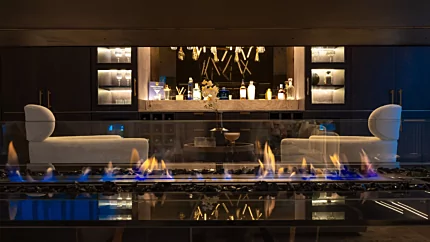
Linear 65 Fire Pit Kit
A custom fire feature usually arrives at the design table as a wish, and leaves as a compromise. The slab needs a gas line. The pergola cannot carry a flue. The covered alfresco rules out wood. The drawing keeps shrinking until the fire is wherever the infrastructure will allow, not where the architecture wanted it. A bioethanol fire pit kit unwinds that sequence. The burner is the only fixed element, and the surround is yours to design. What follows is a working specifier's view of how to choose the right kit, design a surround worth building, and install the result so it performs the way the drawing promised.
Loading image...
Linear 65 Fire Pit Kit
An EcoSmart fire pit kit is a modular bioethanol burner system designed to be dropped into a bespoke, non-combustible surround that the specifier or builder constructs on site. It is the engine of a custom fire feature, not a finished product. You decide the form, the material, the height, and the integration with seating or planting. The kit handles combustion.
EcoSmart Fire has been designing and certifying bioethanol burner systems for over two decades, with installations across hotel terraces, rooftop bars, and private residences in more than 75 countries. The fire pit kit range is the part of the catalogue where that experience meets the bespoke build directly.
Each kit ships with the burner, a high-temperature coated stainless steel tray, baffles (on the linear configurations), a 5-litre jerry can, a fire lighter and lighting rod, a bottle adaptor, and decorative black glass charcoal. The build crew supplies the surround, the fuel, and any optional fire screen. There is no flue, no chimney, no electrical run, and no gas plumbing.
That distinction matters because it changes the architecture of the project. A drop-in gas burner pan still asks the build for a gas connection and an outdoor-only siting. A freestanding fire pit arrives ready to use but resists integration. A kit sits between the two, offering full integration into a custom surround without dragging utilities into the design.
Bioethanol is the fuel that frees the design. It burns cleanly enough to be specified indoors with the right accessories, leaves no smoke or ash, and requires no permanent connection to any utility. Wood and gas both ask the project to give something up; bioethanol asks it to give up very little.
A gas build needs a fitter, a permit pathway, and a continuous supply line, or a bottle and regulator that the surround has to accommodate and the designer has to conceal. Many gas fire features are outdoor-only by certification, ruling out a covered pergola or a rooftop with a partial canopy. A wood build needs a chimney, a hearth, an ash plan, and clearances tied to flueing. Both technologies tend to lock the fire into the location the infrastructure prefers, rather than the one the brief asked for.
A bioethanol kit reverses the priority. The siting decision comes first, and the fuel logistics follow. The table below sets out where each technology earns its keep.
Consideration | Bioethanol kit | Gas kit | Wood-burning |
|---|---|---|---|
Fuel infrastructure | Liquid fuel, refilled at the unit | Gas line or bottle, regulated | Cord, kindling, ongoing supply |
Flue or chimney | Not required | Outdoor-only certification typical | Required, with structural impact |
Covered or indoor use | Possible with the right accessories | Outdoor only | Outdoor only |
Smoke and ash | None | None | Both |
Set-up time | Site prep plus drop-in | Site prep plus licensed plumbing | Hearth build plus flueing |
Approval pathway | Local check on combustible clearance | Gas permit and licensed installer | Building consent in many regions |
The covered-use point is the one most likely to swing a specifier's decision, and it is also the one that the indoor-air-quality conversation belongs to. That conversation is resolved in the dedicated covered and interior section below, where the engineering, the accessories, and the published research sit together.
Loading image...

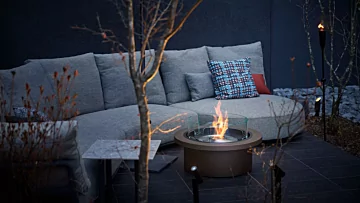 © FUFU Kyu-Karuizawa, Restful Forest
 Loading image...

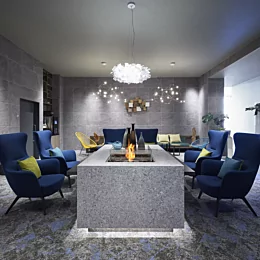
Choosing a kit starts with the location, not the catalogue. Where the fire will live shapes the burner footprint, and the burner footprint sets the surround. A covered alfresco that wraps around a long banquette wants a linear configuration. A centred social moment in a courtyard wants a compact round or square. A rooftop bar with a strict load budget wants the smallest burner the brief can live with.
Bioethanol kits in our fire pit kits collection sit in two families. Compact kits, round and square, use a single AB8 burner and suit a centred focal point in a smaller or more intimate setting. Linear kits use one, two, or three XL900 burners and are the right call for elongated installations: bench-seat integration, a dining-table runner, a divider between two outdoor zones, a long terrace edge. The longer the fire, the more linearity carries the architecture; the more centred the gathering, the more a compact form pays back.
For projects where portability matters more than full integration, EcoSmart's freestanding fire pit range offers an immediate-use alternative without the build commitment. The bowls arrive assembled, sit on a level surface, and move with the layout rather than anchoring it.
Burner output and coverage scale with the configuration. The AB8 burner used in our compact kits delivers around 6 kW (20,433 BTU/hr) and a burn time of seven to nine hours on a single fill. A single XL900 in the smaller linear kits produces 4 kW (15,000 BTU/hr) and runs for eight to thirteen hours on a fill. Doubled and tripled XL900 configurations push coverage out to roughly 120 m² and 180 m² respectively, useful for hospitality terraces where the fire is the room's primary ambience source rather than a supplemental accent.
The selection matrix below maps form to outcome at a glance.
Configuration | Burner | Approximate footprint | Surround scale | Best for |
|---|---|---|---|---|
Compact round | AB8 ×1 | ~630 × 630 mm | Coffee-table to bar-height | Intimate courtyards, private terraces |
Compact square | AB8 ×1 | ~620 × 620 mm | Coffee-table to bar-height | Focal centrepieces, balcony seating |
Linear single (50 or 65) | XL900 ×1 | ~1,200 to 1,630 mm long | Bench-integrated, dining runner | Long banquettes, dining edges |
Linear double (90) | XL900 ×2 | ~2,290 mm long | Architectural feature, hotel terrace | Hospitality social moments |
Linear triple (130) | XL900 ×3 | ~3,375 mm long | Major architectural anchor | Rooftop bars, large alfresco zones |
The combustion side of the equation is worth understanding even when the kit is the only decision in play. For combustion science context, the broader bioethanol fireplaces range covers our full ethanol portfolio and the burner technology that sits behind it.
The same kit reads differently in a private home and in a 200-cover restaurant terrace, and the brief is worth separating early. A residential fire usually runs for an evening or a weekend, refuels infrequently, and gets cleaned a handful of times a year. A hospitality fire often runs through service every evening, refuels in the middle of a busy floor, and demands a surround finish that handles glass spills, traffic, and weather without showing wear.
In practical terms:
Residential brief. Prioritise visual integration, flame profile, and surround material warmth. Smaller burners are usually adequate. Maintenance cadence is light.
Hospitality brief. Prioritise refuel access, burn duration per fill, surround durability, and serviceability. Larger or multi-burner configurations reduce refuel interruptions during peak hours. Specify a fire screen by default for high-traffic settings.
Specifier projects we have supported across hotel terraces, rooftop bars, and restaurant alfresco zones consistently surface the same lesson. The harder the service brief, the more the kit selection benefits from generous burn-time headroom. Plan for the busiest night, not the quiet one.
The surround is the part the guest sees. The burner is engineered; the surround is designed. This is where the kit approach earns its keep, because the surround can be anything the project wants, provided three principles hold.
First, the surround must be non-combustible. Stone countertops, concrete (cast in place or precast), brick, and tile are the materials the kit is engineered around. Combustibles like timber finishes can sit nearby but not directly around the burner opening; a steel or stone insert mediates the heat where the flame meets the surround. Second, the cut-out dimensions in the surround must match the physical tray, not an approximation. Verify the tolerance before the surround leaves the workshop or the form is cast. Third, the visible top surface above the burner, the rim that meets the flame opening, should be detailed to handle thermal cycling without staining or spalling.
The cross-section is simpler than it looks. A non-combustible structural base supports the surround. The surround forms an opening sized exactly to the tray. The tray drops in, sitting on a continuous bearing edge. The decorative top of the surround returns to its design intent on either side of the opening. The glass fire screen, if specified, slots into a recessed channel that is part of the surround design rather than an afterthought.
A footnote worth keeping in mind: surround proportion is harder to get right than surround material. A 2,300 mm tray inside a 2,500 mm bench looks tight and busy; the same tray inside a 3,500 mm bench reads as architecture. Generosity around the burner is almost always rewarded.
Each material gives the surround a different voice, and each carries its own constraint on the build crew.
Cast concrete is the dominant material in contemporary fire feature design, both poured in place and as precast modules. It accepts almost any form, holds heat well around the opening, and pairs naturally with planted or stone-clad gardens. Density and curing matter for thermal performance, and a sealer on the visible top reduces staining.
Natural stone, including basalt, bluestone, limestone, and granite, brings a softer visual register and a more crafted feel. Stone needs a continuous bearing edge under the tray and benefits from a thicker top section to manage thermal movement. Lighter and softer stones can mark if fuel spills are not wiped quickly.
Porcelain and large-format tile sit at the contemporary end of the spectrum. They are light, available in long lengths suitable for linear configurations, and finish-rich. Tile setting around the opening needs a fire-rated substrate and adhesive specified for the temperature range.
Steel, particularly Corten and powder-coated mild steel, gives a sculptural, architectural reading. Steel changes appearance under thermal cycling; this is often the point with Corten, where the patina is an intentional design move. Powder-coated finishes need touch-up planning.
Hardwood timber is acceptable as a near-surround material, suitable for bench tops alongside or decking around the feature, but not as the immediate frame of the flame opening. A non-combustible insert mediates the boundary.
Bioethanol fire pit kits can be installed under cover, including a pergola, an alfresco roof, or a rooftop awning, provided the space has enough air volume to dilute the products of combustion and the surround maintains clearance to the underside of any covering. The principle is simple even though the dimensions belong on a project drawing: combustion needs air, and the cover above the flame must not trap heat against itself.
For interior projects, our kits are rated for indoor use with additional accessories: an indoor safety tray and, for compact kits, an AB8 burner efficiency ring; specific indoor accessories apply to the linear configurations. Minimum room volume is set against the burner. The UL guidance that informs our installation documentation works to 5.7 m³ (200 ft³) of air space per 1,000 BTU/hr of appliance rating. Below that ratio, an adjacent door or window opening of at least 25.4 mm (1 in) provides the supplementary infiltration.
EcoSmart's indoor accessory set, room volume guidance, and ventilation habits exist precisely because the science confirms what the engineering already accounts for: bioethanol combustion in a properly ventilated space performs cleanly. Independent research by Schripp and colleagues, published in Environmental Science and Technology by the American Chemical Society, and subsequent work by Vicente and colleagues in the Journal of Hazardous Materials, establishes that ventilation and accessory compliance are the variables that determine indoor outcomes. Follow the guidance and the kit delivers a real flame in a setting that conventional technology could never enter.
Design checks for a covered or interior installation:
The space's air volume meets or exceeds the minimum for the burner configuration in scope.
The covering above the flame has unobstructed clearance and is not made of a combustible finish.
Existing mechanical ventilation paths are not blocked by the surround structure.
The room has at least one openable door or window in the immediate area.
The kit is treated as decorative or supplemental heat, not as a primary heat source.
A well-designed surround is only half the project; what happens before the tray drops in determines whether the design performs as drawn. Site planning is where the trade brief separates from the homeowner brief, and where most of the issues that surface on commissioning day could have been caught a fortnight earlier.
For an open outdoor build, the base needs to be level, hard, non-combustible at the cut-out, and drained so water does not pool inside the tray. For a covered outdoor build, the airflow analysis from the design section becomes a delivery checklist. For a rooftop installation, the structural load is the first conversation. The triple-burner linear configuration weighs in at around 83 kg before the surround. Once the surround is built around it, the kit's contribution to the rooftop dead load needs to be assessed alongside the live-load expectations the building was designed for. AS/NZS 1170.1 Table 3.1 sets a baseline live-load expectation of 2.0 kPa for trafficable rooftop areas in many residential dwellings, but the right number for a specific project comes from the project's engineer, not a guideline.
A working pre-installation checklist for the trade specifier:
Cut-out dimensions confirmed against the tray to manufacturer tolerance.
Base material confirmed as non-combustible at the cut-out perimeter.
Drainage path confirmed for outdoor and covered-outdoor settings.
Structural load assessed for rooftop and elevated installations.
Air volume calculation completed for covered or indoor sites.
Delivery access mapped, especially for the larger linear trays.
Local authority requirements confirmed (more below).
For Australian projects, surround fixity confirmed against the ACCC 2017 stability rule.
Clearance to seating, planters, and any soft furnishings reviewed against the surround design.
Regulatory environments differ across the markets we ship into. EN 16647 is the governing European and British standard for decorative bioethanol appliances. ANSI Z21.97 and UL 1370 inform the North American framework. The ACCC's 2017 mandatory standard governs Australian supply. NFPA 211 contextualises combustible clearance for fireplace installations in the United States even though flueless bioethanol appliances sit outside its direct scope. Our kits are UL-certified, EN-certified, and compliant with ACCC recommendations for the markets they serve.
The practical point for the specifier is this: certification covers the product; the installation depends on the surround design, the siting, and any local authority requirement. Confirm requirements with the local authority before commissioning. Australian installations of fixed surrounds must hold the kit in place or meet the 8 kg dry-weight and 900 cm² footprint threshold the ACCC standard sets, which the surround design typically handles by default.
Loading image...
The drop-in design is the reason this part of the project goes more smoothly than a gas or wood equivalent. The build sequence is short, and the demanding work is upstream in the surround.
Prepare the base. Confirm the slab, frame, or rooftop substructure is level, dry, and drained. For outdoor builds, position the surround footprint and check the cut-out dimensions against the tray one last time. Combustible substrates outside the immediate cut-out are acceptable; the cut-out itself must be non-combustible.
Build or position the surround. For cast-in-place concrete, this is the form-and-pour stage. For precast or stone, the surround modules are set and dry-fitted. The cut-out opening is the priority. Leave the surround to cure or stabilise before the tray is fitted.
Drop in the tray. With the cut-out clean, lower the stainless steel tray into the opening so it sits on the bearing edge. Confirm the tray sits flat and the rim returns evenly to the surround top.
Position the burner inside the tray. The burner is supplied pre-fitted in most configurations. Confirm orientation and that the slider mechanism is accessible from the intended service position.
Place the decorative media. Add the supplied black glass charcoal so that no media obstructs the burner mouth or interferes with the slider. Decorative media must be larger than the burner's largest opening and should not be substituted with anything that could emit fumes or shatter under heat.
Fit the optional fire screen. If a glass fire screen is specified, slot it into its channel. The screen reduces draught effects in exposed outdoor positions and protects the flame in covered settings.
Commission the installation. Walk through the first-fire procedure below before the project is handed over.
The installation does not require a licensed gas fitter, an electrical run, or a sealed flue. In markets where gas kit variants are available, the gas plumbing introduces a licensed-installer step that the ethanol configuration bypasses entirely.
The commissioning moment is where the design intent meets the physics, and a calm walkthrough beats a rushed one. Fill the burner with approved bioethanol fuel, ignite using the supplied lighting rod, and watch how the flame settles. Look for an even flame across the burner length, a steady plume rather than a flickering one, and no visible flame migration past the burner mouth. In a covered or interior setting, watch how the smoke from the lighting moment clears; if it lingers, the air volume is doing less work than it needs to.
After first-fire checks:
The flame is even across the burner.
The surround opening shows no localised hotspots or staining.
The shut-off slider operates cleanly with the lighting rod (the slider itself stays hot for around 60 minutes after use).
The decorative media has not shifted into the burner mouth.
In covered settings, there is no visible heat trap against the underside of the covering.
Refuelling protocol is understood by the end user: allow the appliance to cool for 60 minutes before refuelling. In daylight, the flame can be difficult to distinguish, so use the shut-off slider rather than visual confirmation before beginning any refuel.
For a trade-delivered project, the handover moment is the right time to walk the end user through the lighting rod, the shut-off slider, and the refuel cycle. A two-minute demonstration prevents most of the operational questions that otherwise surface a week later.
Bioethanol kits are easy to live with, which is part of the appeal. The burner cleans up in a dishwasher, and the surround behaves like any other piece of well-detailed architecture. The maintenance pattern splits cleanly into the burner and the surround.
For the burner, a regular clean keeps the flame even and odour-free. Empty any residual fuel before cleaning (small volumes of ethanol can be disposed of down the drain), wash with mild soap, and dry the burner thoroughly before refilling. Moisture contamination is the most common cause of performance issues. Inspect the burner mouth and the slider mechanism each season; debris around either is the most common cause of an uneven flame. Keep the burner lid closed when the appliance is not in use, especially in outdoor settings where dust and pollen accumulate. The full ethanol burner range shares this maintenance pattern, so a team that has cleaned one of our burners has effectively been trained to clean any of them.
For the surround, the right care depends on the material. Concrete benefits from a periodic reseal and immediate wipe-down of any fuel spill before it stains. Natural stone needs the same attention to spills, plus an annual inspection of the joint between the tray rim and the surround top. Porcelain and tile are the most forgiving and respond well to standard tile cleaners. Steel surrounds, particularly Corten, are designed to weather; the patina is the finish, and intervention is usually limited to keeping organic debris from sitting against the steel for long periods. Powder-coated steel benefits from a touch-up kit kept on site for the inevitable chip.
A tarp or fitted cover during long unused periods extends both burner and surround life considerably, especially in coastal or high-pollen environments.
A bioethanol kit is the right answer when the project wants a custom, integrated fire feature; when the site rules out a flue or a gas line; when a covered or interior placement is part of the brief; or when the hospitality programme needs an architectural anchor with predictable refuel cycles. The flueless, no-utility nature of the kit is the unlock.
A kit is not the right answer when the project wants a fully portable, instant-use fire that can move around the garden. A freestanding bowl from our portable outdoor fire pits range does that job more directly. It is also not the right answer for very large open landscape projects where existing gas infrastructure already supports a built-in solution at lower lifetime fuel cost, or for clients who genuinely want the wood-burning ritual of building a fire from kindling.
For most projects, the kit itself drops in and commissions in a single day once the surround is built. The full timeline is driven by the surround: a precast or modular stone surround can be designed and installed inside a few weeks, while a cast-in-place concrete surround typically adds curing time to the programme. The kit is the fastest part of the build.
Yes, with the right accessories. Indoor use requires the indoor safety tray and, for compact kits, the AB8 burner efficiency ring; specific indoor accessories apply to the linear configurations. The same base kit covers both applications, and the specifier configures it for the site at order time. Minimum room volume requirements apply to the indoor use case and inform the burner selection.
A gas burner pan needs a gas supply, a licensed installer, and is almost always certified for outdoor use only. An ethanol kit needs no utility connection, can be installed without a licensed trade for the kit itself, and is rated for both outdoor and indoor use with the correct accessories. The two products solve similar architectural problems but with very different infrastructure footprints.
The product carries the relevant safety certifications for the markets it serves, but installation requirements vary by jurisdiction. For Australian projects, the ACCC's 2017 mandatory standard sets stability requirements that the surround design usually satisfies by holding the kit in place. Confirm requirements with your local authority before commissioning, particularly for indoor installations and rooftop placements.
The cut-out matches the physical tray dimensions for the chosen configuration: round or square for compact kits, and one of four lengths for the linear range. Verify the tolerance against the product documentation before the surround is fabricated. The drop-in design depends on the cut-out matching the tray, not approximating it.
A bioethanol kit is the part of a custom fire feature that no longer asks the project to compromise. The flame is settled, the surround is yours, and the building does not have to give up a flue, a gas line, or a covered placement to accommodate it. That is the quiet shift the technology makes possible.
The work that pays back is the work upstream of the drop-in: the brief, the surround proportion, the air-volume check for a covered site, the load assessment for a rooftop. Get those decisions right and the kit handles the rest. The fire stops being an infrastructural problem and becomes the social centre the design was always reaching for.
A fire feature that finally sits where the architecture wanted it is a small change with a long shadow. It is what an evening on the terrace, a Thursday in the lobby bar, or a Saturday around the courtyard quietly turns into when the fire is no longer asking the building for permission, and it is the same shift that runs through the broader outdoor fire pits collection whatever form the project finally takes.