Loading image...

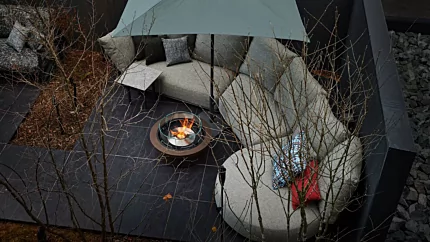 © FUFU Kyu-Karuizawa, Restful Forest
 Round 20 Fire Pit Kit
Most people choosing a fire pit kit agonise over size and fuel, then pick a shape in about thirty seconds. It's usually the wrong order. Shape is the decision that quietly determines how the space gets used: who faces whom around the flame, how guests move through the area, what the fire frames when you look across it, and whether the feature converses with the architecture around it or argues with it. Round, square, and linear aren't three versions of the same product. They're three different design languages, and each one organises a gathering in its own way. Get the geometry right and everything downstream, from seating to circulation to atmosphere, falls into place almost on its own.
Loading image...
© FUFU Kyu-Karuizawa, Restful Forest Round 20 Fire Pit Kit
A fire pit is the one element in an outdoor space that everyone orients towards. Furniture can be rearranged, planting can be edited, lighting can be re-aimed. But once the fire is set, the room arranges itself around it. That makes the choice between fire pit kit shapes less a question of taste and more a question of behaviour: a circle pulls people into conversation, a square aligns a zone to the grid of the hardscape, and a long rectangle leads the eye along an edge or towards a view.
There's a second reason shape deserves more attention than it usually gets. Because EcoSmart Fire's fire pit kits are self-contained drop-in units, shape selection isn't hostage to chimney positions, flue runs, or where a builder happened to leave a service point. The tray, burner, and decorative glass charcoal drop into a non-combustible surround you design yourself, which means the geometry can be chosen for the space rather than for the plumbing.
The drop-in logic comes from a brand that has built its name on certified bioethanol fire features: every ethanol burner in the range is UL 1370 listed, EN 16647 BSI certified, and compliant with ACCC recommendations, covering the United States, Europe, the UK, and Australia, and the burner technology behind the linear series carries a Hearth & Home Vesta Award. We'll come back to what that freedom unlocks; first, the three shapes on their own terms.
Loading image...

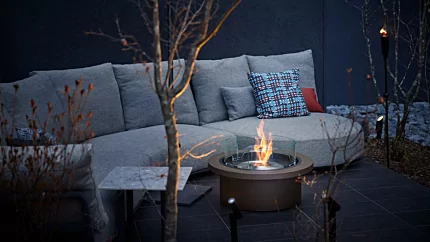 © FUFU Kyu-Karuizawa, Restful Forest
 Round 20 Fire Pit Kit
The circle is the oldest seating plan in human history, and it still works for the same reason it always has: everyone sits equidistant from the flame, nobody occupies the head of the table, and conversation flows across the fire rather than down a line. A round fire pit kit reproduces that radial logic in a contemporary package. Drop the round tray into a stone, concrete, or tiled surround and the geometry does the social engineering for you.
Round also does something subtle for the landscape itself. Most hardscapes are built from straight lines: decking boards, pavers, retaining walls, the rectilinear footprint of the house. A circle interrupts that grid gently, softening the composition the way a curved path or a round planter does. It's why round fire pit kits sit so comfortably in cottage gardens, coastal settings, and naturalistic planting schemes, and why designers reach for them when a courtyard needs a centre of gravity rather than another edge.
Round earns its place wherever people can approach the fire from every direction:
Open lawns and garden clearings, where the fire becomes a freestanding destination
Courtyard centres, where the circle anchors the space without competing with its walls
Curved or organic landscape designs, where rectilinear forms would feel imposed
Gravel, boulder, and informal settings that suit a softer geometry
Gathering zones built for conversation first and viewing second
The Dezeen editorial team has documented this pattern in built work: at Casa SS in Chile, architects Pablo Saric and Cristian Winckler arranged deck chairs around a circular steel fire pit in an enclosed sandy courtyard, letting the round form organise the seating into a natural ring.
A round fire pit assumes a 360-degree audience, and that assumption shapes everything around it. Seating works best as a radial arrangement: a ring of individual chairs, a curved bench following the circle's arc, or low lounges angled inward. Circulation needs to flow all the way around, because half the pleasure of a round fire is that there's no back of house; the flame reads identically from every angle. Plan walk-around clearance on all sides and resist the urge to push the feature towards a boundary. A circle against a wall is a circle doing half its job.
Round struggles in spaces that have a strong directional pull. A narrow side terrace, a long pool deck, a tight corner of a courtyard: in each of these, a circle either blocks the natural line of movement or wastes most of its viewing arc against a wall or balustrade. And in rigorously rectilinear modern landscapes, a circle can read as an interruption rather than a counterpoint. When the architecture is all parallel lines, the fire often wants to speak the same language.
Loading image...


Square 22 Fire Pit Kit
Square is the architectural middle ground. It keeps the communal quality of round, since people can still sit on all four sides facing one another, but it aligns to the grid of the hardscape instead of cutting across it. Where a circle interrupts straight lines, a square echoes them: the joints in the paving, the edges of the decking, the cubic planters, the rectilinear footprint of a contemporary home. For modern landscape design, that alignment is often exactly the point.
Within EcoSmart Fire's range, the Square 22 carries the same compact, drop-in logic as its round sibling, with a tray that integrates into square or rectangular settings such as a custom coffee table or a cubic surround. The visual effect is different in kind, not just in outline. A square fire feature reads as built-in even when it's a freestanding element, because its edges find and extend the geometry around it.
Square comes into its own in defined zones. An outdoor room framed by an L-shaped lounge, a courtyard with crisp boundaries, a terrace organised into functional quadrants: in each case the square anchors the zone the way a rug anchors a living room. It's also the most forgiving shape for corner placements. A circle adrift in a corner looks like it's lost; a square slotted near a corner looks deliberate, its edges parallel to the walls that frame it.
Contemporary architecture is built on repetition of rectilinear forms, and a square fire pit kit extends that rhythm out into the landscape. Pair the kit with a cubic surround in concrete or stone and the fire feature becomes part of the architectural composition rather than an object placed in front of it. At AutoCamp in California, Anacapa Architecture gathered chairs around a square floor-level hearth, a reminder that square can be every bit as social as round while holding a much stricter line. The discipline of the form is the appeal: nothing about a square apologises for being designed.
Square does ask one thing of the planner that round doesn't: attention to its corners. The corners of a square surround project into circulation paths differently from a curve, so placement near walkways deserves a moment of thought, particularly in busy entertaining areas where guests move with drinks in hand. Like every shape in the range, a square kit needs generous side clearance from furniture and ample overhead clearance from anything that can move in the wind, such as overhanging branches. Square earns its anchored look through deliberate placement rather than improvisation. Where square genuinely struggles is the informal garden: among curving paths, loose planting, and naturalistic materials, a hard-edged square can feel like a visitor from another project.
Loading image...

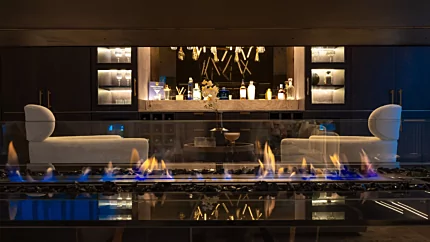
Linear 65 Fire Pit Kit
If round is a point of flame and square is an anchored block of it, linear is a ribbon. A linear fire pit kit stretches the fire into a long, low band of flame, and that single change rewrites what the feature can do. The fire stops being a destination you gather around and becomes a line that defines an edge, divides a space, or leads the eye towards a view. It's the shape architects reach for when the fire needs to do compositional work, not just social work.
The linear format is also the most scalable geometry in the range. EcoSmart Fire's linear fire pit kits run from a compact length suited to intimate terraces up to a flame more than three metres long, which means the ribbon can be sized to the wall, terrace, or frontage it's tracing rather than forcing the space to adapt to the fire. The longest model in the series, the Linear 130, is positioned for spacious residential and commercial settings as a divider, a definer, or a design element integrated within a benchtop or dining table.
Linear dominates the settings the other two shapes can't serve:
Pool surrounds and pool edges, where the long flame doubles itself in the water
Retaining walls and raised garden beds, where the fire traces an existing line
Long, narrow terraces where a round or square feature would choke circulation
Boundary and privacy lines, where the flame defines the edge of a space after dark
Dining-table adjacency, with the fire running parallel to the table as a warm backdrop
Hotel and restaurant frontages, where the ribbon of flame reads from a distance
The pool pairing deserves particular mention. At the Desert Fairway Residence in Arizona, Kendle Design Collaborative specified a linear fire feature on the front terrace alongside a slender pool, with Dezeen noting that the feature provides warmth on cooler nights while enhancing the atmosphere. Flame reflected in still water is one of the oldest tricks in landscape design, and a linear fire is the shape that exploits it fully: the reflection extends the ribbon, effectively doubling the installation's visual length at no extra cost.
A linear fire changes how a space reads from a distance. Where a round fire pulls focus inward to a single point, a long flame elongates the space visually, drawing the eye along its length towards whatever sits at the end: a view, a sculpture, the dark line of a garden boundary. Designers use this deliberately, placing the linear feature so that it leads sightlines from the main living area out towards the landscape's best moment. For a narrow terrace, the effect is even more useful. A ribbon of fire running parallel to the long axis makes the space feel longer and more generous, where a centred round feature would only emphasise how little width there is to spare.
Seating logic shifts completely with a linear fire. Instead of a radial circle, think theatre: a single row of lounges facing the flame with the view beyond, or two parallel benches with the fire running between them. The flame becomes a backdrop rather than a centrepiece, which suits spaces where people want to face outward, towards a pool, a skyline, or a garden, with the fire warming the foreground. The honest trade-off is conversation geometry. A linear fire will never produce the face-to-face circle that a round one creates effortlessly. If the brief is long evenings of cross-fire conversation, linear is the wrong tool; if the brief is atmosphere, edge definition, and a view, nothing else comes close.
Self-contained bioethanol fire pit kits require no flue, chimney, gas line, or fixed utility connection, which means round, square, and linear fire features can be placed in covered, semi-enclosed, rooftop, and even indoor settings that a connected unit can't reach. That single fact changes the shape conversation more than anything else in this article, because it removes the open-backyard assumption that most fire pit advice quietly carries.
Every kit in the range is available in a bioethanol configuration built around a removable stainless-steel burner: the compact AB8 burner in the round and square kits, and the elongated XL900 burner, in one, two, or three units, across the linear series. The burner sits inside the drop-in tray, the fuel lives inside the burner, and nothing needs to be trenched, plumbed, or vented. The practical consequence is that geometry can follow design intent rather than infrastructure. A round centrepiece can sit in the middle of a lawn fifty metres from the house. A linear ribbon can run along a rooftop parapet where no gas line will ever go. A square anchor can hold a semi-enclosed courtyard without a flue penetrating the roof above it.
The bioethanol configurations of all six kits are rated for indoor or outdoor use, which is where shape selection gets genuinely interesting. A covered alfresco room, a pergola-shaded lounge, an indoor-outdoor living space: these are the settings most fire pit guidance writes off, and they're available to every shape in the fire pit kits range. Architectural Digest's coverage of a Japandi-style Los Angeles renovation by designer Shanty Wijaya describes a custom-built bioethanol concrete fireplace, smokeless and ventless, integrated directly into the home's sustainable material palette: a fire feature placed by design logic, not by flue logic.
Indoor use is supported in all bioethanol configurations, subject to the following requirements. Complying with EN 16647 means fitting the Indoor Safety Tray and, for the round and square kits, the AB8 Burner Efficiency Ring before operating inside, and each model carries a minimum room volume for indoor operation. EcoSmart Fire's guidance also sets a ventilation threshold: where less than 5.7 m³ [200 ft³] of air space is available per 1,000 BTU/h at maximum burner setting, keep a door to an adjacent room open or open a window at least 25.4 mm [1 in]. In practice, this means a standard living room running the fire at full output needs a door cracked or a window slightly open, a modest step the installation guide confirms for each model. For covered outdoor areas, the same air-volume logic applies; suitability depends on the total volume of air around the feature, not simply on whether the space is labelled outdoor. Research from Politecnico di Milano confirmed that burner design and adequate ventilation are the factors that govern indoor air quality outcomes, which is why certified burner geometry and the published room-volume minimums matter. These kits are designed as supplemental and decorative fire features, not as a primary heat source, and treating them that way keeps the indoor experience exactly as intended.
A fire feature connected to a fixed fuel source is anchored to wherever that infrastructure was installed. The shape decision then has to work around the infrastructure rather than the other way around: the linear ribbon goes where the service run already exists, not where the terrace wants it. A self-contained bioethanol kit has no such constraint, which is why the covered terrace, the rooftop, and the far corner with no service runs are all available to every geometry in the range.
It's also worth knowing that connected gas-fuelled fire features are rated for outdoor use only, so if the perfect spot for your ribbon of flame is a covered alfresco room or an interior-adjacent space, the bioethanol configuration is the version of that shape that can actually live there. For the shape question, the rule of thumb is simple: bioethanol lets the geometry go wherever the design wants it; a fixed connection asks the geometry to meet the infrastructure halfway.
In a venue, shape selection stops being about personal taste and starts being about guest behaviour. The fire feature has a job: drawing guests towards a destination, defining the edge of a terrace, signalling warmth from the street, or giving a rooftop its photograph. Each geometry performs a different one of those jobs, and the better hospitality projects choose accordingly.
Round draws guests inward. It creates destination seating, the spot people migrate to and stay at, which is why fire pits anchor so many lodge and resort common areas. Hospitality Design's coverage of Yonder Escalante in Utah, designed by Anacapa Architects with ROY Hospitality Design Studio, describes the fire pit as the centrepiece of the property's indoor-outdoor lodge. Linear does the opposite job: it defines edges, guides movement, and reads from a distance, which makes it the natural choice for entry approaches, pool decks, and terraces viewed from inside a dining room. The Godfrey Hotel Hollywood put fire pits to work on its 12,000 sq ft rooftop pool deck for exactly this reason; at that scale, the fire is as much wayfinding and atmosphere as it is warmth. Square suits modular terrace zones, repeating cleanly across a series of identical seating bays. As a quick pairing guide:
Linear for frontages, pool decks, and any edge guests should read from a distance
Round for destination lounges where guests settle and stay
Square for modular terrace zones and rectilinear courtyard bays
Large projects rarely specify one fire feature; they specify a rhythm of them. A series of identical linear units along a venue frontage or pool deck creates visual cadence, the same way a row of columns or a run of identical pendant lights does. The linear series supports this directly: the mid-length models are positioned for homes and intimate commercial settings, the larger formats for expansive areas where a single unit can work as a centrepiece, a room divider, or a definer of one section within a multi-use space. Because every unit in a repeated series drops into an identical surround detail, the documentation, procurement, and maintenance story stays simple even when the installation runs the length of a terrace.
The drop-in architecture is what makes shape a genuinely open specification question for designers. The kit supplies the tray, the burner, the decorative glass charcoal, and the optional fire screen; the project supplies the surround, in whatever material matches the venue's architecture, from board-formed concrete to natural stone to corten steel. The surround can be any geometry the design calls for, because the fire-making components arrive as a packaged unit that integrates into a non-combustible cut-out.
For venues where gas infrastructure is unavailable, or where the feature needs to sit in a covered or interior zone, the bioethanol configurations carry certifications across the major markets: UL 1370 listing, EN 16647 BSI certification, and compliance with ACCC recommendations. For a specifier, that means one fire-feature detail can travel across a portfolio of properties in different regions without redesign.
Round fire pit kits suit communal, freestanding settings; square kits anchor modern rectilinear spaces; linear kits suit pool edges, narrow terraces, and architectural frontages. The table below compares the three geometries across the criteria that actually drive the decision.
Criterion | Round | Square | Linear |
|---|---|---|---|
Seating style | Radial conversation circle | Four-sided or L-shaped framing | Theatre-style rows, single or two-sided |
Best settings | Open lawns, courtyards, garden clearings | Outdoor rooms, modern terraces, corners | Pool edges, narrow terraces, boundaries, frontages |
Architectural match | Organic, coastal, naturalistic | Contemporary, rectilinear, minimalist | Architectural, resort, statement-led |
Viewing experience | 360-degree, flame as centrepiece | Anchored, flame as zone marker | Directional, flame as backdrop and sightline |
Space character | Needs all-round access | Defines and fills a zone | Elongates and traces an edge |
Covered or indoor placement | Yes, in bioethanol configuration | Yes, in bioethanol configuration | Yes, in bioethanol configuration |
In a compact courtyard, square usually wins: it fills the zone without demanding the all-round circulation a circle needs, and its edges align with the walls that define the space. An open garden flips the answer to round, since a freestanding circle becomes the destination the lawn was missing. A long pool terrace belongs to linear, with the flame doubled in the water and the seating facing the reflection. A covered alfresco room can take any of the three in bioethanol form; choose by seating intent, with round for conversation and linear for atmosphere against a view. A modern rectilinear landscape favours square or linear, whichever continues the strongest line in the composition. And a commercial frontage is linear territory almost by default, because a ribbon of flame is legible from the street in a way a point of flame never is.
One reassurance to carry into the decision: shape and surround material are independent choices. Because the kit drops into a custom-built enclosure, you can commit to the geometry that suits how you gather and then design the surround, in concrete, stone, steel, or tile, to suit the architecture. The fire pit kits collection covers all three geometries with the same drop-in logic, so the shape decision never locks you out of the material palette you had in mind.
Round is the strongest conversation shape because every seat sits equidistant from the flame and guests face one another across it, creating a natural circle. Square preserves much of that face-to-face quality while suiting modern rectilinear spaces; linear prioritises atmosphere and views over cross-fire conversation.
For most pool surrounds, yes. A linear fire pit runs parallel to the water's edge, reflects its full length in the pool, and leaves the deck's circulation paths clear, whereas a round feature interrupts movement and reflects poorly. Round still suits a separate lounge zone set back from the water.
Yes, in the bioethanol configuration. All shapes in EcoSmart Fire's kit range are rated for indoor or outdoor use with bioethanol, provided indoor requirements are met, including the Indoor Safety Tray, minimum room volume, and ventilation guidance. Gas configurations are rated for outdoor use only.
Linear. A long, slim fire pit runs parallel to the terrace's long axis, preserving the walkway while visually elongating the space. Round and square shapes force circulation around all sides, which a narrow footprint can't comfortably provide.
No. All three shapes share the same drop-in installation logic: the tray and burner integrate into a non-combustible surround such as stone, concrete, brick, or tile. The differences between shapes are dimensional, footprint and weight, rather than procedural, so shape choice doesn't change the installation approach.
Shape was never decoration. Choosing between a round, square, and linear fire pit kit is choosing how people will gather, what the flame will frame, and how the feature will speak to the architecture around it. Round gathers, drawing a circle of faces towards a single point. Square anchors, holding a zone to the grid of a modern landscape. Linear leads the eye, tracing an edge or stretching a space towards its best view.
And because these are self-contained drop-in kits, none of the three is locked out of the covered, elevated, or interior spaces where the most interesting fire features now live. The geometry can follow the design rather than the infrastructure. The shape worth choosing is the one that matches how you actually live and host, not the one that happens to be most familiar; the fire will organise everything around it either way, so it may as well organise it the way you intended.