Loading image...
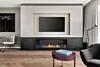
 © Herbert / Architecture: @taltamir_architecture.design / Photo: @odedsmadar
 Flex 68SS
Minimalism is unforgiving. A single chimney chase, a stray brass trim, a mantle that does not need to be there, and the discipline of the room collapses. The wall stops reading as one plane and starts reading as a stack of compromises. Specifying a fireplace into a contemporary minimalist interior is, in practice, a battle to keep that plane intact.
That is why so many architects end up with a single-sided format. One viewing aperture, one wall plane, one confident focal point. Multi-sided formats fragment the wall and turn into room dividers, which is a different design conversation. Single-sided sits flush, faces forward, and asks nothing else of the architecture.
But the format alone does not finish the job. The fuel inside the firebox decides whether the wall stays unbroken or quietly capitulates to a flue, a vent termination, or a gas service. That is the argument this article makes, and where it begins.
Loading image...
© Herbert / Architecture: @taltamir_architecture.design / Photo: @odedsmadar Flex 68SS
Four principles do most of the work in a minimalist interior, and each one is something a poorly chosen fireplace can break.
Unbroken wall planes. Walls read as continuous surfaces. A chimney chase, a flue penetration, or a recessed vent grille interrupts that continuity and pulls the eye away from the considered composition.
A restrained material palette. Concrete, plaster, micro-cement, honed stone, brushed steel, smoked oak, matte ceramic. The palette is small on purpose. A brass trim ring or a decorative cast surround introduces a material the room never agreed to.
Considered proportion. Negative space is a design element, not leftover area. The fireplace aperture has to take its proportion from the wall composition around it, not the other way around.
Honest materials. Surfaces show what they are. A faux-stone veneer or a printed laminate dies on contact with this kind of room.
A short way to put it: nothing in the wall should argue with the wall. Megan Walden at Bespoke Fireplace Designs frames it as a question of seamless transitions, and even a small material shift can break the effect. Architectural Digest attributes the same discipline to leading designers: "Clean lines and simplicity of materials make fireplaces modern while ensuring they fit into minimalist interiors." The fireplace decision sits inside that constraint, not outside it.
Bioethanol and electric are the only single-sided fireplace fuels that preserve a minimalist interior's unbroken wall plane, because neither requires a flue, a gas line, or a chimney chase.
Conventional fuels each demand something structural of the wall. Wood-burning asks for a flue penetration and the mass that comes with it. Direct-vent gas asks for a vent termination on an outside wall and a service connection running into the room. Both compromise the very plane the minimalist scheme exists to protect. The fix is not better trim work. The fix is choosing a fuel whose architecture is ventless to begin with.
Bioethanol is the purest minimalist fuel because it is a real flame with none of the infrastructure. e-NRG bioethanol is a high percentage alcohol fuel formulated for unvented decorative appliances, and the combustion produces only heat, water vapour, and minimal carbon dioxide at levels that natural air infiltration in typical home construction handles without supplemental ventilation. No smoke, no soot, no ash. The wall stays whole, the indoor air stays clean, and the entire installation can land in an afternoon without specialist trades.
Electric earns its place for a different reason. The thinness of the unit. Slim-depth ranges in single-sided fireplaces let the appliance recess into a shallow wall or slot inside a continuous joinery run without furring the plane out. The appliance functions as ambience rather than as a heating source, particularly on a flame-only setting where the heater is dormant and the operating cost falls close to zero.
Fuel | Wall penetration required | Vent path | Indoor air impact | Minimalist verdict |
|---|---|---|---|---|
Wood | Flue penetration, chimney mass | Vertical flue | Smoke, soot, ash | Breaks the plane |
Direct-vent gas | Vent termination, gas line | Exterior wall vent | Sealed combustion | Compromises the plane |
Bioethanol | None | None | Heat, water vapour, minimal CO2 | Preserves the plane |
Electric | None | None | None | Preserves the plane |
The decision matrix is short on purpose. Anything that needs to leave the room ends up announcing itself on the wall.
Loading image...

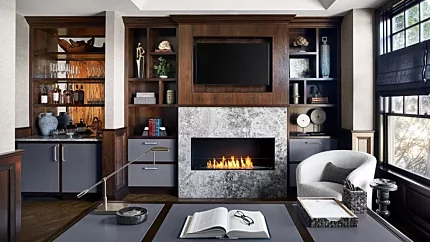 © @dualconceptdesign / Photo: @rymcdon
 Each of the four single-sided ranges answers a different design intent. The point is not which one is best. The point is which one is right for the room.
The Flex Single Sided range is the linear ribbon-of-flame, and it is the range specifiers reach for when the wall composition is already set and the fireplace has to match a planned proportion. A constant height across all sizes lets the designer specify against an existing horizontal datum with confidence, and the Black Glass Charcoal media reads cleanly inside a monochrome palette. It belongs in projects where the wall composition leads and the fire takes its place inside that composition.
The Frame SS fireplace range is an architectural centrepiece with its signature protruding border. A toughened low-iron glass screen, a fully customisable finishing material around the aperture, and the broadest documented certification footprint of the four ranges, listed to UL 1370 in the USA, certified to EN 16647 for the UK and Europe, and compliant with ACCC recommendations in Australia. For multi-market practices specifying once and rolling out across regions, that triple-layer of independent third-party scrutiny is what matters at the documentation stage.
The Switch range (available in the USA and Canada) is a wide linear electric format, at 292 mm deep. Switch FX flame customisation and a flame-only mode mean the appliance behaves as ambience in spaces where heat is not the primary brief: a hotel lobby, a foyer, a corridor termination. The Motion range (also available in the USA and Canada) goes further on the depth question. At 239 mm deep, it is the shallowest single-sided format in the EcoSmart Fire portfolio and one of the shallowest available. Motion Picture Technology gives a multi-dimensional flame for designers who want realism inside a flush, recessed wall installation. Indoor only.
A note on cost that is worth getting out of the way. Bioethanol installs without a gas fitter, a flue installer, or a structural engineer, which keeps the total significantly below a built-in gas fireplace once trade fees are counted. Electric is the most affordable to run on flame-only mode. Across the four ranges, the spread is meaningful, but the design decision should never lead with the cheapest line item. It should lead with the wall.
Loading image...

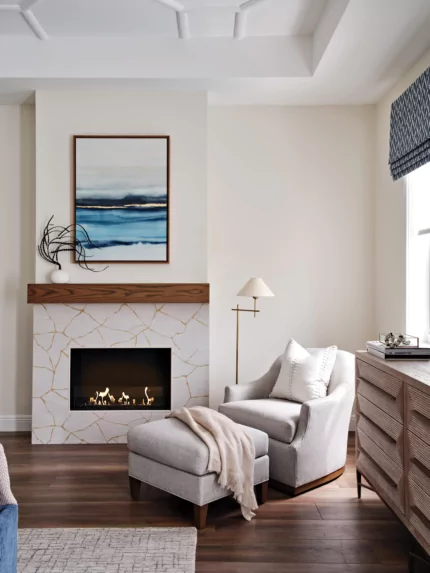 © Firefinish Interiors / Photo: Dan Cutrona
 Flex 32SS
The standard black powder-coat surround across the four ranges sits cleanly inside the material vocabulary minimalism actually uses, concrete, plaster, micro-cement, honed stone, brushed steel, smoked oak, matte ceramic. Avoid high-gloss laminates and decorative veneers. Most of those are not approved for the immediate surround anyway, since the substrate has to be non-combustible. The honest material palette and the safety substrate list are pointing at the same set of finishes, which is convenient and not accidental.
The proportion question is where most of the design work gets done. A horizontal linear flame wants a horizontal wall composition around it. Centre the viewing aperture on the dominant sight-line from the room's primary seating arrangement, and align the top edge with adjacent horizontals already in the architecture, door heads, shelving lines, window mullions. With Flex SS, the constant height across the range simplifies the planning, since the same datum holds whatever width you specify. With Frame SS, the width is the variable that does the work, and the right answer is whichever width matches the existing rhythm of the wall.
Flush millwork integration is where ventless ranges show their real advantage. The fireplace surround is not load-bearing above the appliance, so designers can run continuous joinery across the wall without breaking it around a structural chase. Non-combustible substrates such as HardieBacker, Durock, plaster, tile, concrete, steel, brick, slate, and glass are required in the immediate surround, but those are precisely the materials a minimalist scheme already wants in that location.
Before the fireplace lands on the drawings, a short specifier checklist makes the difference between a clean install and a redesign.
Confirm the room volume meets the minimum for the chosen bioethanol size. Bioethanol ranges have specific minimums tied to burner capacity and configuration. Electric ranges have no room volume requirement.
Confirm the surround substrate is non-combustible. HardieBacker, Durock, plaster, tile, concrete, steel, brick, slate, and glass are approved options for the immediate surround.
Confirm the frame structure above the appliance is self-supporting. The fireplace surround does not carry load above the unit.
Confirm mantle and surround clearances against the published minimums for the chosen range.
Confirm the appliance cavity remains open at all times. Sealed enclosures and insulation in the air spacers are not permitted.
Confirm the certification requirements for the project's market. Frame SS is independently certified across three major regulatory regimes. Other ranges may require separate market verification.
The checklist is short because most of the variables resolve themselves once the substrate, the room volume, and the certification region are fixed. Get those three right and the rest is detail work.
Minimalism's rule is that nothing in the room should argue with the wall, and a single-sided fireplace is one of the few elements large enough to break that rule on its own. The format part of the answer is straightforward. One aperture, one plane, one focal point.
The fuel part of the answer is the part most specifications get wrong. Wood and direct-vent gas both ask the wall to give something up. Bioethanol asks nothing, and electric asks even less. Neither will out-heat a wood-burning insert, and electric will never be a real flame. Those trade-offs are honest. They are also the price of keeping the plane whole.
Choose the fuel that lets the wall stay whole, then choose the range that matches the room's proportion. The discipline does the rest.