Loading image...
Manhattan 50
In most living rooms, the fireplace is chosen last. The sofa lands first, the rug defines the floor, the TV claims its wall, and the fire is squeezed in wherever the chimney happens to be. The room ends up shaped by a flue that nobody actually loves.
Flip the sequence and freestanding fireplace living room styling becomes a different exercise. A bioethanol, ventless freestanding fireplace has no flue, no chimney breast, no structural anchor. It can sit centre-room, against a wall, in a corner, or on the threshold between living and dining. Once you let it lead, every other piece of the room falls into place around it.
The rest of this guide walks through how to plan that room, using EcoSmart Fire's clearance specifications as design rules and the freestanding range as the worked example.
Loading image...
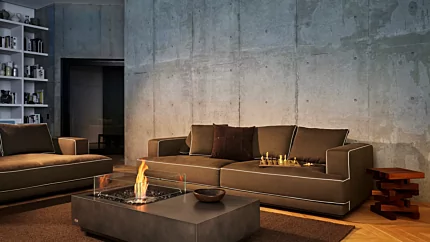
Manhattan 50
A freestanding bioethanol fireplace is a piece of three-dimensional furniture, not a wall feature. Bioethanol freestanding fireplaces have no flue, so the unit can sit anywhere the room volume and clearance rules allow. That single fact rewrites the layout brief.
In a built-in install, the fire is fixed before the room is planned. The mantel becomes a horizon line, the hearth dictates the rug, and seating arranges itself in a semicircle facing one wall. Useful, but inflexible. Move the sofa and the room loses its anchor.
A freestanding unit reverses that relationship. The fire travels with the design intent. Want a room that reads from two seating zones? A dual-sided unit in the centre. Want an open-plan space that still feels separated by use? A cylindrical unit between zones acts as a soft divider. Want the fire to read from the kitchen island and the dining table as well as the sofa? Pull it off the wall.
This is why specifying a fireplace and laying out the room are really the same decision. The conversation about freestanding vs built-in fireplaces usually centres on installation cost, but the bigger payoff is design freedom: the room you can plan when nothing is fixed to a wall.
Four specs decide where a freestanding fireplace can go in a living room: minimum room volume (40 to 116 m³ depending on model), 600 mm [23.6 in] clearance from furniture, a hard non-combustible floor, and a fixed floor anchor. Treat them as design rules first and safety paperwork second.
Rule | Specification | What it means for the room |
|---|---|---|
Room volume | 40 m³ [1,413 ft³] for most models; 70 m³ for Igloo; 116 m³ for T-Lite 8 and Pop 8 | Match the model to the room before you fall in love with the form |
Clearance | 600 mm [23.6 in] minimum from fixed furniture; 2,000 mm [78.7 in] overhead from movable items like curtains or trees | Defines the conversation circle and the ceiling treatment above |
Floor surface | Hard, non-combustible only; no carpet, grass, artificial turf, or rock | Style rugs around, not beneath; concrete, tile, or hardwood reads through |
Floor anchor | Ground-fixing brackets bolt the unit to the floor | The unit's position is a permanent decision, not a styling whim |
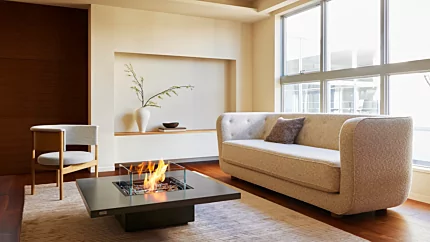
The clearance rule is the one most people underestimate. Six hundred millimetres looks generous on a plan and tight in a room. A two-seater sofa, a club chair, and the fire form a triangle with sides of at least 600 mm from each piece of furniture to the flame. Drop the rug inside that triangle and the seating reads as one composition. The fire occupies the negative space.
Floor finish is the other detail that quietly steers the styling. Polished concrete, large-format tile, oiled hardwood, and microcement all qualify. A wool rug can sit beneath the seating but must stop short of the unit. That gap between rug edge and fire base is intentional: it gives the appliance breathing room and visually separates the heat source from the soft furnishings around it.
Loading image...

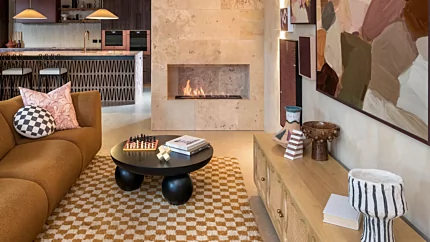
XL900 Ethanol Burner
Corners are the hardest geometry in a living room. A built-in fireplace cannot turn a corner without compromising the flue, so corners usually get a console, a plant, or nothing at all. A dual-sided freestanding unit fixes that. Place it where two walls meet and the flame reads from both seating directions. At over 50 inches tall it carries vertical weight, which a corner needs. Pair it with two sofas at right angles and the corner becomes the focal point the room has been missing.
Open-plan living/dining/kitchen layouts gain warmth from a fire, but the wrong fire kills the openness. A cylindrical 360-degree unit with an elevated flame solves both problems. Set it off-centre between the living zone and the dining zone and it acts as a sculptural marker without blocking sightlines. The flame reads from every seat (sofa, dining chair, kitchen stool) and the cylinder form is narrow enough that traffic flows around it.
Small rooms are unforgiving. A footprint under 14 inches square reads as furniture, not infrastructure. The Pop 3 range fits that brief at 13.8 inches per side, light enough to reposition seasonally. The Mello takes a different angle: at 18.7 inches tall in Fluid Concrete, it doubles as a side table. Either approach earns its floor space twice over, which is the test small rooms apply to everything in them.
A larger room needs both heat and presence. Higher-output models in the range cover up to 116 m³ [4,096 ft³], which is enough for most generous open-plan living rooms in detached homes. Pair the higher-output unit with a deep modular sofa and at least two club chairs so the seating answers the scale of the fire. Anything smaller and the fire looks oversized; anything larger and the seating drifts out of the 600 mm conversation circle.
Some rooms want the fire to behave like an art object. A tall stainless steel and glass unit, transparent on all sides, does exactly that. Place it in front of a window and the flame layers over the view. Place it mid-floor and seating wraps around it on three sides. The transparency means it doesn't divide the room visually, so it works in rooms where you want a centrepiece without a barrier. For more on how the range covers different design styles in EcoSmart freestanding fireplaces, the freestanding category page details each finish family.
Loading image...
Vertigo 40
Material choice is where the fireplace stops being an appliance and starts being part of the palette. EcoSmart Fire's freestanding range is built across four material families, and each one suggests a different room.
Fluid Concrete, available in Natural, Graphite, and Bone, reads as architectural and mineral. It pairs naturally with warm timbers, plaster walls, and the Belgian-style interiors that have been quietly dominating high-end residential work for the past few seasons. Graphite anchors a moody scheme; Bone lifts a room with cool light; Natural reads almost geological.
Teak takes the same forms in a different register. A teak-clad fire table sits in a Scandinavian or Japandi scheme with no friction at all. Teak weathers and develops character, which is the opposite of stainless steel's reading. Designer Rayman Boozer captures the principle that runs through both choices: limit the number of materials and let them be the story.
Stainless steel suits crisp modern interiors with polished concrete floors, glass partitions, and a minimal furniture vocabulary. It is the right answer for spaces where the architecture is already doing most of the work and the fire needs to be precise rather than tactile.
Bold powder-coat colours read as decorative object first and heat source second. Black and white powder-coat sit in mid-century rooms with playful furniture; saturated tones like orange or yellow are punctuation marks in an otherwise neutral palette. A coloured freestanding unit is the fastest way to give a quiet room a focal point without adding a feature wall.
The reliable instinct, regardless of finish, is contrast paired with restraint. The Room Genius design studio puts it well: cold materials like concrete and stainless steel benefit from warm, natural elements alongside them. Stone, plaster, timber, linen, and wool keep the temperature of the room in balance with the flame.
A freestanding unit that earns two jobs at once is the highest-leverage piece in a small or mid-sized living room. The Mello is the clearest expression of that: a Fluid Concrete fireplace and side table in one, standing at 18.7 inches tall and weighing in light enough to move with a second person's help. Flame on for evenings, glass top down for a tray of glasses and books during the day.
Fire tables extend the same logic in different proportions. A fire table at coffee-table height becomes the centrepiece of the seating arrangement; with a glass cover it converts to a closed surface when the flame is off. Multi-fuel options in the range take bioethanol, propane, or natural gas, which matters when the room sometimes hosts a long winter dinner and other times needs only a quick ambient flame.
The styling rule for dual-purpose pieces is to commit to the doubling. If the fireplace is also a side table, it must be approached from at least two seating positions, not parked against one wall. If the unit converts between flame mode and tabletop mode, the surrounding surfaces should accommodate both states: a tray or vessel that lives there when the flame is off, then moves cleanly when the flame returns.
For broader thinking on how these forms fit a contemporary scheme, our piece on sustainable freestanding fireplaces covers the material and lifecycle case alongside the styling one.
Loading image...

XL900 Ethanol Burner
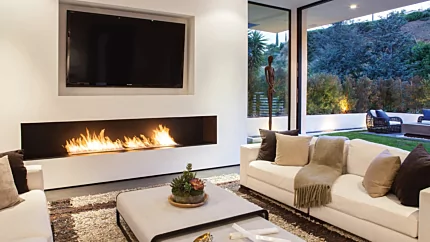
EcoSmart Fire approves three configurations for mounting a TV above a freestanding bioethanol fireplace: a non-combustible ledge between the flame and the screen, a recessed niche set 300 mm [11.8 in] above the flame opening, or a TV plane set back at least 300 mm [11.8 in] from the flame.
Configuration | What it does | Best fit |
|---|---|---|
Non-combustible ledge | Horizontal interruption protects the screen from rising heat | Wall-mounted TVs above taller units with vertical flame profile |
Recessed niche, 300 mm above | TV sits inside a recess set above the flame, the cavity shields it | Architectural wall builds where the niche is part of the design |
Setback plane, 300 mm from flame | TV mounted on a wall plane that steps back from the fire's vertical line | Rooms where the fire stands forward of the TV wall |
The taller units in the range pair naturally with the ledge approach because the flame already sits at a higher line, leaving room above for screen mounting. Lower units like the Mello or Pop 3 sit better below a fully separate TV wall, where the fire is the eye-level focal point and the screen is treated as secondary.
A small aside that comes up on almost every project: the question is rarely whether the TV can go above the fire, but whether it should. A fireplace and a screen compete for the same attention in the same vertical zone. If the room is used mostly for conversation, give the fire that wall and put the TV on a side wall or a media unit. If the room is genuinely a media room, lead with the screen and let the fire sit lower, where it warms the space without competing for sightlines.
A freestanding fireplace is a design brief in itself. The four placement rules set the geometry, the material choice sets the palette, and the model match resolves the scale. Plan in that order and the rest of the room falls in line: seating finds the conversation circle, the rug stops at the safe edge, the floor finish reads through, and the flame becomes the thing the whole room is arranged around.
The right starting point is usually the room, not the catalogue. Measure the volume, identify the geometry, look at what the floor will allow, and then choose the unit that suits both the architecture and the way the room is actually lived in. From there, the styling decisions stop feeling like compromises and start feeling like consequences.
To see the full range across the material families and room scales discussed above, browse our freestanding fireplaces collection.