Blog

  /  

Sustainable Modern Freestanding Fireplace Options

Sustainable Modern Freestanding Fireplace Options

"Sustainable" sits on more fireplace product pages than any single word has earned the right to. It signals intent without explaining what the manufacturer actually did to deserve it. For anyone who cares about the difference between a marketing claim and a material decision, that is a frustrating place to shop from. The shortcut is to stop trusting the word and start interrogating the four things underneath it: the fuel that runs the fire, the materials that hold it, the certifications that vouch for it, and the design that decides how long any of it stays in the room.

This article walks through those four criteria as a buying framework, and uses EcoSmart Fire's freestanding range as the worked example. By the end you should be able to read any product page critically and know what the brand is actually offering, not just what it is calling itself.

Published:
· Updated:

What makes a freestanding fireplace genuinely sustainable

A genuinely sustainable freestanding fireplace combines four things: a clean-burning, renewable fuel; durable, long-life materials; independent safety certification appropriate to the market; and a design built to outlast trend cycles rather than feed them. Miss any one of those and the sustainability claim starts to wobble. A bioethanol fire in a disposable carcass is no better than a wood-burner in a heritage stone surround. The materials and the fuel are equal partners.

The four criteria, in the order this article works through them:

  • Fuel:renewable, clean-burning, flueless.

  • Materials:long lifespan, honest construction, recyclable at end of life.

  • Certification:third-party verified safety against UL, EN, and ACCC benchmarks.

  • Design longevity:archetypal form that earns its place across decades, not seasons.

The freestanding form factor itself does sustainability work that built-in alternatives can't. A piece you can move with you carries no chimney to demolish, no flue to rebuild, no structural cavity to fill if the room is reconfigured. We come back to that in the design section. For a wider comparison of how different fireplace fuel types stack up environmentally, our companion article on the environmental impact of freestanding fireplace types goes deeper. This piece stays inside the bioethanol freestanding fireplaces collection and treats it as the category of choice for a sustainability-led buyer.

Fuel matters: why bioethanol leads the sustainable category

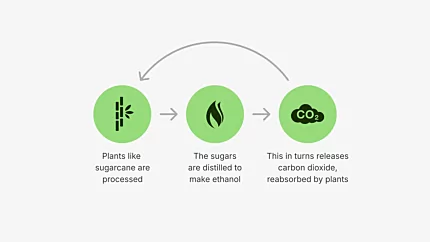
Clean-burning bioethanol produces only three things when it burns: heat, water vapour, and minimal CO₂. No smoke, no soot, no ash, no carbon monoxide, no flue. That short list is what sets bioethanol apart from every other fireplace fuel category and why it is the natural starting point for a sustainable choice.

The renewable side of the story matters too. Bioethanol is fermented from plant feedstocks like sugarcane and corn, and second-generation production uses agricultural residues that would otherwise be waste. According to research published in Proceedings of the Royal Society A by Jeswani, Chilvers and Azapagic, biofuels can achieve lifecycle greenhouse gas emissions up to 60% lower than fossil fuel alternatives, with second-generation pathways pushing higher still. Because there is no flue, all of the combustion heat stays in the room rather than venting straight out of the building, which is a quiet efficiency gain on top of the carbon picture.

The differentiator most product pages skip: not all bioethanol burns the same. Fuel purity and alcohol concentration directly affect flame quality, burn cleanliness, and the carbon-neutrality claim attached to it. Generic methylated spirits or low-grade denatured alcohols leave residues and burn unevenly. e-NRG bioethanol is formulated specifically for the ethanol burners used across the EcoSmart Fire range, and the fuel grade is part of what holds the safety and emissions claims together. A high-quality burner running poor fuel produces a worse fire than the spec sheet promises.

For a detailed look at how the burner mechanism works and what responsible indoor use looks like, the freestanding fireplaces FAQ panel covers both.

Materials that earn their lifespan

Sustainability is a materials story as much as a fuel story. A fireplace built from durable, repairable, honestly finished materials lasts longer, gets replaced less often, and stays out of the throwaway-design cycle that ages a room in five years and a landfill in fifty.

Three material decisions are worth interrogating on any freestanding fireplace.

Why stainless-steel grade affects fireplace longevity

The burner and structural components are the working parts. Grade 304 stainless steel is the benchmark: corrosion-resistant, dimensionally stable across temperature swings, and infinitely recyclable. The British Stainless Steel Association puts service life for Grade 304 at 30 to 50 years in most environments, and indoor applications routinely exceed that. A self-repairing chromium oxide layer keeps that surface intact decade after decade. Lower grades save money on the build sheet and cost it back on the replacement cycle.

Natural marble, oak, and brass as long-life finishes

The visible materials carry the design lifespan. Italian Carrara marble, Turkish Nero Portoro marble, real oak veneer, and brushed brass brackets are the kind of finishes that show their age as character rather than wear. The Pillar 3L and Pillar 3T pair these materials with the burner architecture, and the combination is honest in a way that printed-laminate facsimiles never quite manage. Natural stone in particular is a multi-century material; once cut and finished, a marble pillar outlives the fireplace it is built around.

Borosilicate glass and durable transparency

Where glass is used for the flame enclosure, borosilicate is the grade to look for. It handles the temperature differentials that come with an open flame without clouding, weakening, or yellowing, and unlike standard soda-lime glass it is fully recyclable at end of life. A toughened or borosilicate screen is a one-time decision rather than a recurring replacement.

The Orbit freestanding fireplace is the lead worked example for this argument. It is built from low-impact materials, fuelled by renewable bioethanol, and positioned explicitly as a sustainable fire rather than a fashion piece. A rotating top section means the flame can face the room or face away as the use of the space changes, which is the kind of small functional detail that quietly extends the years of use a single object earns.

Certifications worth checking before you buy

A sustainable freestanding bioethanol fireplace should carry UL 1370 (USA), EN 16647 BSI (UK and Europe), and comply with the ACCC's 2017 mandatory standard (Australia). Those three together cover the markets the category sells into, and they verify different things in different ways.

Be precise on the language. UL 1370 and EN 16647 are independent third-party certifications that the product carries. The ACCC's Consumer Goods (Decorative Alcohol Fuelled Devices) Safety Standard 2017 is a mandatory compliance standard, not a certificate; products either meet it and can be sold in Australia, or they don't and can't. Writing that a product is "ACCC-certified" is a category error you will see on plenty of product pages, and it is worth knowing how to read past.

Standard

Region

What it covers

UL 1370

USA

Decorative ethanol-fuelled appliances: construction integrity, fuel spillage, stability, accidental ignition. Over 100 laboratory tests.

EN 16647 BSI

UK and Europe

Flueless ethanol-burning fires for decorative use: emissions limits, ventilation requirements, construction.

ACCC 2017 (mandatory)

Australia

Freestanding ethanol fireplaces: minimum dry weight 8 kg, footprint at least 900 cm², flame arrester required, permanent warning labels.

The ACCC thresholds are worth memorising because they are concrete: a freestanding ethanol fireplace sold in Australia has to weigh at least 8 kg and sit on a footprint of at least 900 cm². That is the regulator's answer to tip-over risk, and it filters out the lightweight novelty models that gave the category a rough patch a decade ago. The EcoSmart Fire range complies across all three markets.

The practical takeaway: ask any seller for certification documentation. Reputable manufacturers publish it openly, and a refusal to share the paperwork is its own answer.

Design longevity: why timeless form is a sustainability decision

The most overlooked sustainability factor is the design itself. A freestanding fireplace that looks dated in five years gets replaced, and the replacement carries its own embodied carbon, its own manufacturing footprint, and its own shipping mileage. A piece designed to outlast trends stays in the room. The first decision is restraint.

The Ghost freestanding fireplace is the case study for this. Minimalist toughened glass, a flame that appears to hover untethered, almost no visual mass. That kind of design restraint is harder to do than feature-heavy alternatives, and it is the reason the silhouette still reads as contemporary years after the trend cycle has moved on. Orbit takes the opposite route, sculptural and room-anchoring and deliberately object-like, and arrives at the same destination because the form is archetypal rather than referential. Both are doing the same thing: refusing to chase a moment.

Portability is the second sustainability lever that freestanding form unlocks. The T-Lite series uses a bung system that lets the burner move between indoor and outdoor settings, which doubles the contexts a single object earns its keep in. A fireplace that can come with you when you move, switch rooms, or step out to the terrace lives a longer life than a built-in alternative ever will.

A brief aside on the embodied carbon people rarely cost into a built-in fireplace: the demolition. Removing a chimney, sealing the flue, patching the floor, and rebuilding the structural cavity has a carbon and labour cost that gets paid the day the room changes. A freestanding fireplace simply moves. That is not a small thing on a long enough timeline, and it is the most under-credited environmental argument the format has going for it.

How to choose the right sustainable freestanding fireplace for your space

Three decisions get the choice right.

Sizing the burner to the room

Match heat output and ventilation volume to the room. Bioethanol consumes the same oxygen any open flame does, and adequate room volume is non-negotiable. As a rough guide, an AB3 burner produces 2 kW (6,825 BTU/hr) and suits rooms around 20 m² [215 sq ft] with a minimum room volume of 40 m³ [1,413 cu ft]. A BK5 burner produces 4 kW (13,650 BTU/hr) and serves up to 35 m² [377 sq ft] / 70 m³ [2,472 cu ft]. An AB8 burner produces 6 kW (20,475 BTU/hr) and handles up to 60 m² [646 sq ft] / 116 m³ [4,096 cu ft]. Undersizing the burner gets you a fire that struggles to read in the room. Oversizing it pushes ventilation requirements that the space can't meet.

Indoor, outdoor, or both

Some models are indoor-only, some are dual-environment, some are outdoor-rated. Igloo and the Pillar series sit firmly in the indoor category, with refined finishes and interior-scale silhouettes. The T-Lite series and the Pop series move comfortably between indoor and covered outdoor settings. Mini T is built for the open terrace. Choosing the wrong environment shortens the life of any fireplace, and the warranty alongside it.

Clearance and surface essentials

Confirm clearances before placement. Allow 600 mm [23.6 in] from any fixed furniture, 2,000 mm [78.7 in] of overhead clearance, and a hard, flat, heat-stable surface underneath. These aren't safety theatre; they are the conditions the certifications were tested against. A 15-minute cooling period before refuelling is the other discipline worth respecting. For the full range alongside each model's room-size, environment, and clearance profile, the designer freestanding fireplaces collection lays the comparison out side by side.

Bringing it together: sustainable design without compromise

The most overlooked sustainability factor is the design itself. A freestanding fireplace that looks dated in five years gets replaced, and the replacement carries its own embodied carbon, its own manufacturing footprint, and its own shipping mileage. A piece designed to outlast trends stays in the room. The first decision is restraint.

What we hope this gives you is a way to read product pages with more confidence and less patience for vague claims. The sustainability case for a well-built freestanding bioethanol fireplace doesn't need exaggeration; it just needs to be made specifically. If you would like to see the four criteria applied across our 14 designer models, the freestanding fireplaces collection is the place to start.

References

Related Articles

Freestanding Fireplaces

Freestanding vs Built-in Fireplaces: Which is Right for Your Home?

Buying Guides
Choosing the perfect fireplace for your home involves more than simply deciding between wood or gas.

Styling Your Living Room Around a Freestanding Fireplace

Design Trends
How to style a living room around a freestanding bioethanol fireplace — placement, clearances, model selection, and material pairings.

The Environmental Impact of Different Freestanding Fireplace Types

Sustainability
Compare wood, gas, electric, and bioethanol by environmental impact.