Loading image...
Blog
/
The Bioethanol Fireplace Fuel Guide: How Ethanol Burns, Sustainability, and Environmental BenefitsThe Bioethanol Fireplace Fuel Guide: How Ethanol Burns, Sustainability, and Environmental Benefits
Two litres of clear liquid, a steel tray, and a flame that holds steady for an entire evening with no smoke drifting up a chimney that isn’t there. That’s the part most people notice first. What they rarely ask is what’s actually happening in that tray, where the liquid came from, or whether the word “sustainable” on the label holds up to scrutiny. The fuel is the quiet engine of the whole experience, and the difference between a flame that dances clean and one that sputters and smells comes down almost entirely to what you pour in.
Bioethanol fireplace fuel is simple chemistry, but the fuel sets the flame, the air quality, the burn time, and the environmental footprint of every fire you light, so it earns a careful look. It’s also the reason EcoSmart Fire can put a real flame where a traditional fireplace cannot: no flue, no chimney, no fixed position dictated by a masonry wall. Get the fuel right and the rest of the fireplace does exactly what its designer intended.
- Author:
- Rachel Glass
- Contributors:
- Guillaume Stevelinck
- Published:
- · Updated:
What is bioethanol fuel?
Bioethanol is a renewable liquid fuel made by fermenting the natural sugars in plants. The feedstocks are crops most people already recognise from the supermarket: sugarcane and corn are the two most common, along with other plant material rich in starch and sugar. Yeast converts those sugars into ethanol through the same fermentation process that has produced alcohol for thousands of years, and the resulting liquid is then distilled to a high concentration suitable for clean combustion.
The “bio” in bioethanol matters. Because the carbon in the fuel comes from plants that absorbed carbon dioxide while growing, the feedstock itself is part of a short, repeating cycle rather than carbon pulled up from deep geological storage. This is the distinction that separates bioethanol from fossil fuels, and it’s the foundation of every sustainability claim worth making about the fuel.
You’ll sometimes see the term “denatured ethanol” used alongside bioethanol, and the two are not in conflict. Denaturing simply means a small amount of a bittering or denaturing agent has been added to make the ethanol undrinkable, which is standard practice for fuel-grade alcohol worldwide. A well-made bioethanol fuel is denatured ethanol that has been refined and formulated specifically for decorative fires, with the purity and additive profile controlled so the flame behaves the way it should. Across every EcoSmart Fire range, from the ethanol burners through to the built-in fireplace inserts, e-NRG is the bioethanol fuel specified for exactly this reason.
How bioethanol burns
Loading image...


Under complete combustion, bioethanol produces carbon dioxide and water vapour, and ventilation is required for all indoor use. That single sentence carries more nuance than it first appears.
When ethanol meets enough oxygen and ignites cleanly, the reaction is tidy. The carbon and hydrogen in the alcohol bond with oxygen from the air to form CO2 and H2O, releasing heat and producing the warm, orange flame you see. There’s no solid residue in this ideal reaction, which is why a properly running ethanol fire leaves no smoke, no soot, and no ash. Across EcoSmart Fire’s ranges, that clean-combustion behaviour is built into the burner design, and the product files describe the output plainly: heat, water vapour, and carbon dioxide, with no flue, chimney, or utility connection required. That absence of a flue is also what frees the fire from the room’s structure, so placement follows the design rather than the chimney breast.
Real rooms are not laboratories, and this is where the chemistry earns its nuance. Combustion is only “complete” when there’s ample oxygen available. In an undersized or poorly ventilated space, the same fire can shift towards incomplete combustion, which is why every credible discussion of ethanol fires returns to airflow. A chamber study by Tobias Schripp and colleagues, published in the American Chemical Society journal Environmental Science & Technology, measured carbon dioxide and nitrogen dioxide concentrations approaching or exceeding indoor air guideline values in a small unvented test room, and noted that decorative fires of various fuel types can act as sources of fine particles. That study examined an unvented test room of 48 m³, a condition EcoSmart Fire’s ventilation requirements are specifically designed to prevent. Every burner in the range is UL 1370 listed and EN 16647 certified, and the minimum room volumes are set precisely so that oxygen supply and combustion stay on the clean side of that line.
This is also why bioethanol fuel quality feeds directly into how the fire burns. A purer fuel with a tightly controlled formulation burns more completely, which keeps the combustion on the clean side of that line.
The environmental benefits of bioethanol
Loading image...


Bioethanol’s strongest environmental credential is its place in the carbon cycle. Because the fuel is made from recently grown plants rather than fossil reserves, the carbon dioxide released when it burns is broadly the same carbon the feedstock absorbed from the atmosphere while growing. The European Union recognises this in its Renewable Energy Directive, which treats bioethanol as a renewable fuel that reduces greenhouse gas emissions compared with fossil alternatives.
The real number holds up well to scrutiny. A 2024 meta-analysis by Bouterab and colleagues in Biomass and Bioenergy, drawing on 566 lifecycle assessment observations, reported a median lifecycle carbon footprint of around 40 grams of CO2 equivalent per megajoule, substantially below fossil fuels and wood, with the best-performing feedstocks doing better still. The full picture spans farming, distillation, and transport, so “carbon-neutral fireplace fuel” is best read as shorthand for the combustion stage. The environmental story is strong precisely because it can be measured.
The comparison with wood is where the contrast turns vivid. The United States Environmental Protection Agency notes that wood smoke carries fine particulate matter, benzene, formaldehyde, acrolein, and polycyclic aromatic hydrocarbons, all of which can affect breathing and the heart. The World Health Organization goes further, classifying alcohol fuels alongside solar, electricity, biogas, LPG, and natural gas as clean household fuels, while identifying wood, charcoal, and coal as primary sources of harmful household air pollution responsible for serious harm to people on a vast scale each year. A clean-burning ethanol flame sits firmly in the better category by that authority’s own framework.
There’s a quieter environmental benefit that designers tend to appreciate more than homeowners expect: a fire that needs no flue needs no masonry, no steel flue liner, and no roof penetration. The embodied carbon of a chimney is rarely counted in fireplace comparisons, yet it’s substantial. Removing it from the equation is its own kind of sustainability, and it is the same flue-free freedom that lets these fires sit on a partition wall or a kitchen island rather than against a structural chimney.
Indoor air quality: the honest picture
Loading image...

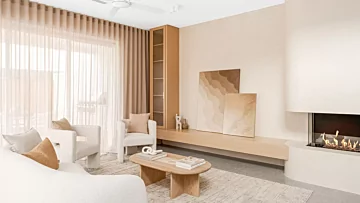
That flue-free freedom comes with one condition the previous section only touched on: the room still has to feed the flame. Bioethanol is classified by the World Health Organization as a clean household fuel, but “clean” describes complete combustion in an adequately ventilated space, not an unconditional promise regardless of room size. The two ideas have to travel together.
When an ethanol fire runs in a room large enough to feed it oxygen, combustion stays complete and the by-products are the benign pair of carbon dioxide and water vapour. When the room is too small or sealed too tight, oxygen depletes, combustion turns incomplete, and the air quality picture changes. EcoSmart Fire has spent over two decades engineering its burners around these airflow realities, which is why every model in the range documents a specific minimum room volume rather than leaving ventilation as an afterthought, and why those figures scale with the burner. A compact burner is approved for a modest space, while a large multi-burner configuration needs a far bigger room to breathe.
The supporting standards make the requirement concrete rather than vague. EcoSmart Fire burners are UL 1370 listed in North America, tested by OMNI-Test Laboratories against the standard for unvented alcohol fuel burning decorative appliances, and EN 16647 certified in Europe and the United Kingdom for decorative bioethanol fireplaces. In Australia, the ranges meet the mandatory safety standard for decorative alcohol fuelled devices administered by the ACCC. The practical ventilation rule that underpins these approvals is straightforward: provide at least 5.7 m³ [200 ft³] of air space for every 1,000 BTU/hr of appliance rating at its maximum setting, and if a room falls short, keep a door open or a window cracked at least 25.4 mm [1 in].
One honest note belongs here, because it shapes how the fuel should be used. EcoSmart fireplace inserts are designed for the role where a fire earns its place, supplemental warmth and a living flame that anchors a room, not as a utility heating system. That’s a distinction, not a limitation. People with breathing difficulties should speak to a physician before using any open fire indoors, and a full 60-minute cool-down before refuelling is mandatory across the range. None of this makes ethanol a fuel that needs avoiding. It makes it a fuel that rewards using as intended.
Bioethanol fuel quality and why it matters
Not all bioethanol is equal, and the flame is where the difference shows up first. Fuel purity, alcohol concentration, and the additive package all change how the liquid combusts, which in turn changes the brightness, the height, and the steadiness of the flame you watch all evening. A fuel formulated specifically for decorative burners burns predictably; a generic or contaminated alcohol can produce a weaker flame, an odour, or an inconsistent burn.
This is the reasoning behind EcoSmart Fire specifying e-NRG bioethanol across every product range, including the built-in fireplace inserts at the heart of this cluster. e-NRG is formulated for the brand’s burners, so the alcohol concentration and purity are matched to the way those burners are engineered to atomise and combust the fuel. Switching to a different fuel isn’t simply a matter of pouring something else in; the brand’s guidance is that a burner must be cleaned before changing over from a non-e-NRG fuel, because residues and differing additive chemistries don’t mix well.
There’s a parallel worth a brief mention. Anyone who has run a precision engine on the wrong octane fuel knows the machine still runs, just not the way it was built to. A decorative burner is far simpler, but the principle holds: the fuel and the hardware are a matched pair, and the flame quality is the reward for respecting that. When the question is which is the best bioethanol fuel for fireplaces, the most defensible answer is the fuel the burner was designed and certified around.
Burn performance in practice
Burn time and heat output are properties of the burner, not the fireplace surround it sits inside, so it pays to look at the engine rather than the housing. Across EcoSmart Fire’s ethanol burner family, run times sit broadly in the seven-to-fourteen-hour range on a single fill, with heat output scaling alongside fuel capacity. These values are indicative only and vary with the model, the installation, and the fuel composition, which is precisely why fuel quality belongs in any performance conversation.
A few burners illustrate the spread. The compact AB3 burner holds 2.5 L [0.7 gal] and runs for roughly 8 to 11 hours at 5,800 BTU/hr (2 kW), which is enough quiet warmth to take the edge off a small sitting room while the flame does the real work as a focal point. Step up to the XL900 burner, used in larger inserts across the Flex and Heritage ranges, and a 9 L [2.4 gal] fill produces around 15,000 BTU/hr (4 kW) over an 8-to-13-hour evening, comfortably warming an open-plan living space through a long dinner without a top-up. The BK5 burner, common in the more compact Heritage models, holds 5 L [1.3 gal] and runs 7 to 11 hours at 13,000 BTU/hr (4 kW), a steady mid-range output that suits a feature wall in a bedroom or study. The pattern is consistent: more fuel and a larger burner buy more heat and a longer burn, and every one of those figures assumes a clean, correctly specified fuel feeding the flame.
What the numbers translate to in a real room is an evening that doesn’t ask anything of you. No reloading mid-conversation, no tending, no managing a fuel bed. The fire is lit when the guests arrive and still holding steady when they leave, and the fuel is doing all of that quietly in the background.
How to store bioethanol fuel safely
Bioethanol is a flammable liquid and should be stored sensibly, which is straightforward once you know the thresholds. It carries a Dangerous Goods Flammable Liquid Class 3, Packing Group II classification, meaning ethanol can form a flammable vapour mixture at ordinary room temperatures. That classification sounds formal, but it translates into a short set of habits rather than anything onerous.
For indoor storage, keep quantities modest and away from ignition sources. EcoSmart Fire’s guidance allows permit-free indoor storage up to around 5 gal [20 L], with larger outdoor quantities above roughly 10 gal [40 L] typically triggering a permit requirement depending on your jurisdiction. In Australia, domestic storage of flammable liquids including ethanol is governed by AS 1940, the standard for the storage and handling of flammable and combustible liquids, which gives the thresholds a regulatory backbone.
A few practical rules cover the rest:
Store fuel in a cool, well-ventilated area, away from heat sources and naked flames.
Keep it in its original or an approved container. The container must not be red, which is reserved for petrol under dangerous goods conventions and would mislabel the contents.
Remove ignition sources from the storage area, and never decant near an open flame.
Always observe the mandatory 60-minute burner cool-down before refuelling, and never add fuel to a warm or lit burner.
Stored with that ordinary care, bioethanol is as straightforward to keep at home as any other considered design choice in the room. The classification simply makes the sensible precautions explicit.
How to choose bioethanol fuel for your fireplace
The right bioethanol fuel is the one your fireplace was engineered and certified to burn, and for EcoSmart Fire that means e-NRG. The reasoning runs through everything above: a matched fuel keeps combustion complete, which protects indoor air quality; it holds a consistent flame, which is the whole point of a decorative fire; and it’s formulated to the purity the burner’s UL and EN approvals were tested against. Pouring an unverified alcohol into a certified appliance quietly undoes part of what that certification guaranteed. e-NRG is available in Australia, the United States, Canada, the United Kingdom, and via the global storefront; customers in EU markets should source a locally certified bioethanol fuel formulated to the same purity and concentration standards.
When you’re weighing a fuel, a short checklist keeps the decision sound. Start with the formulation match: a fuel specified for your burner protects both the flame quality and the certification, where an improvised alcohol does neither. Purity and the additive package come next, because higher-purity ethanol with a controlled additive profile burns cleaner and more predictably than a generic alcohol of uncertain composition. Then there is the question of sourcing.
Renewable sourcing. A fuel made from fermented plant feedstocks carries the carbon-cycle advantage that makes bioethanol worth choosing in the first place.
Clear safety information. A reputable fuel comes with storage thresholds, handling guidance, and a dangerous goods classification stated plainly, not hidden.
For anyone specifying a built-in fire, the fuel decision and the appliance decision are really one decision. The range of modern fireplace inserts is designed around a single, certified fuel, and keeping that pairing intact is what lets the fire perform the way the brief imagined.
Frequently asked questions
Is bioethanol fuel eco-friendly?
Bioethanol is a renewable fuel made from fermented plant feedstocks, so the carbon released when it burns is broadly the carbon those plants absorbed while growing, which gives it a substantially lower footprint than fossil fuels or wood. A 2024 lifecycle meta-analysis reported a median footprint of around 40 grams of CO2 equivalent per megajoule, with the exact benefit depending on the feedstock. It is a strong environmental choice rather than a zero-impact one, and the most accurate framing keeps that distinction visible.
What does bioethanol produce when it burns?
Under complete combustion in an adequately ventilated space, bioethanol produces carbon dioxide and water vapour, with no smoke, soot, or ash. In an undersized or poorly ventilated room, combustion can become incomplete and the air quality picture changes, which is why every burner specifies a minimum room volume and why ventilation is required for all indoor use.
What’s the difference between denatured ethanol and bioethanol?
The two terms describe the same well-made fuel from different angles. Denaturing means a small bittering agent has been added to make ethanol undrinkable, which is standard for all fuel-grade alcohol, while bioethanol describes ethanol made from renewable plant feedstocks. A quality fireplace fuel is denatured bioethanol that has been refined and formulated specifically for decorative burners.
How should I store bioethanol fuel at home?
In practice, storage comes down to a cool, well-ventilated spot, an approved non-red container, and distance from heat and naked flames. Indoor quantities are typically permit-free up to around 5 gal [20 L], with larger outdoor volumes subject to local permit rules. Ethanol is a Class 3 flammable liquid, so removing ignition sources from the storage area and never decanting near a flame covers the essentials.
Why does fuel quality affect the flame?
Purity, alcohol concentration, and the additive package all change how the fuel combusts, which directly affects the brightness, height, and steadiness of the flame. A fuel formulated for a specific burner burns predictably, while a generic alcohol can produce a weaker, odorous, or inconsistent flame. This is why EcoSmart Fire specifies e-NRG across its ranges and advises cleaning a burner before switching over from any other fuel.
The fuel is the fire
Strip a bioethanol fireplace back to its essentials and the fuel is what’s left doing the work. It decides whether the flame holds steady or wavers, whether the air stays clean or the room feels close, and whether the environmental story holds up under a careful eye. The chemistry is genuinely elegant: a renewable liquid that burns to little more than carbon dioxide and water vapour when given the oxygen to do so completely, and a fire freed from the chimney that once dictated where it could live.
That last condition is the thread tying the whole guide together. The same complete combustion that makes the fuel clean is what makes it sustainable, and the same purity that keeps the flame beautiful is what keeps the air good to breathe. Respect the ventilation, match the fuel to the appliance, store it sensibly, and a bioethanol fire delivers on every promise the design made. Choose the fuel as carefully as you chose the fireplace, and the fire will keep faith with the room for as long as you light it.
References
- Indoor air quality in relation to the use of decorative ethanol-fuelled fireplaces. Retrieved 04/06/2026,From https://doi.org/10.1021/es404972s
- A meta-analysis of the lifecycle carbon footprint of bioethanol. Retrieved 04/06/2026,From https://doi.org/10.1016/j.biombioe.2024.107418
- Household air pollution and health. Retrieved 04/06/2026,From https://www.who.int/news-room/fact-sheets/detail/household-air-pollution-and-health
- Wood smoke and your health. Retrieved 04/06/2026,From https://www.epa.gov/burnwise/wood-smoke-and-your-health
- Renewable Energy Directive (EU/2023/2413): biofuels. Retrieved 04/06/2026,From https://energy.ec.europa.eu/topics/renewable-energy/bioenergy/biofuels_en
- AS 1940:2017: The storage and handling of flammable and combustible liquids. Retrieved 04/06/2026,From https://store.standards.org.au/product/as-1940-2017