Loading image...

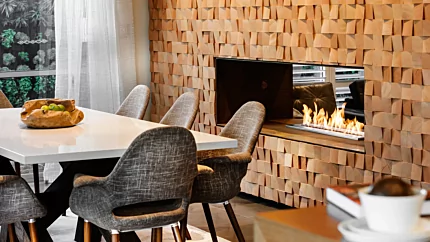
XL900 Ethanol Burner
Ethanol burners change what it means to have a real flame at home. You get the warmth, movement, and focal point of a traditional fireplace, without the smoke, soot, or ash that usually comes with it.
Burning plant-based bioethanol in a closed carbon loop, these burners release only heat, water vapour, and a small amount of CO₂, so there is no need for a flue, chimney, or gas line. For eco-conscious homeowners, that combination of clean combustion, vent-free operation, and efficient heat retention is a practical way to lower a home’s footprint while still enjoying a genuine live fire.
Loading image...
XL900 Ethanol Burner
The conventional assumption is that a real flame requires a compromise. You either accept the environmental costs of wood or gas, or you forego the fire altogether. Plenty of homeowners have made peace with that trade-off for years, until bioethanol burners changed the terms of the conversation.
The appeal is straightforward: you get a live, responsive flame with no chimney to build, no gas line to connect, and no fossil fuel combustion to justify. The shift is measurable, too. Verified Market Reports (2025) documents significant growth in the bioethanol fireplace market, driven specifically by homeowners seeking eco-friendly heating options. This isn't a fringe trend finding its feet; it's a category that has earned mainstream credibility.
For anyone whose home choices are part of a broader set of values, that credibility matters. Choosing a heating solution that holds up to scrutiny is a different kind of satisfaction to simply choosing the most convenient one.
Clean burning means the fuel combusts completely, leaving no harmful residue. Ethanol burners burning e-NRG bioethanol produce only heat, steam, and a small amount of CO₂: no smoke, no soot, no ash, and no airborne particulates.
Wood fires release smoke, carbon monoxide, and fine particulate matter. Gas fires produce CO₂ and, depending on combustion conditions, trace nitrogen oxides. Bioethanol combustion is a different chemistry. The fuel burns completely, which means nothing is left over to settle on walls, clog air passages, or require extraction through a flue.
Researchers at Advances in Mechanical Engineering confirmed in a 2024 study by Il-Seok Kang and colleagues that bioethanol has excellent effects on reducing exhaust emissions compared to traditional fossil fuels, and identifies it as a viable alternative with significant potential for addressing air pollution and global warming. A separate investigation published in Building and Environment, led by Elena Nozza and a team at the Politecnico di Milano, examined the indoor air quality profile of ventless bioethanol fireplaces and confirmed that the clean-burning combustion byproducts distinguish them meaningfully from wood-burning alternatives.
What this translates to in practice: no soot settling on furniture, no smoke smell absorbing into soft furnishings, and no need for the kind of ongoing maintenance that wood fires demand.
Ethanol burners produce:
Heat
Water vapour
A small amount of CO₂
Loading image...

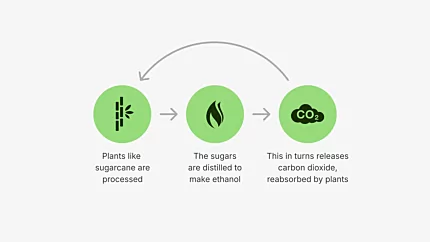
Here's what separates bioethanol from other fuels at a biological level. Plants absorb CO₂ from the atmosphere as they grow. Those plants are fermented into bioethanol. When the fuel combusts, it releases the same CO₂ back into the atmosphere, where the next generation of plants absorbs it again. The carbon travels in a loop, not a line.
Fossil fuels work differently. Gas and coal release carbon that has been locked underground for millions of years, permanently adding to the atmospheric total. Bioethanol recirculates what's already there. That's not a carbon-accounting convention; it's a biological mechanism.
A 2023 peer-reviewed review in Bioengineered by A. Devi and colleagues confirmed that bioethanol is renewable, nontoxic, and carbon-neutral, and that advances in production technology (including the shift from food-crop feedstocks to second and third-generation agricultural waste) have strengthened those credentials considerably. EcoSmart's e-NRG bioethanol is produced from fermented plant sugars, including sugarcane, and all EcoSmart Fire models run exclusively on e-NRG. The fuel's origin is the starting point of that closed loop.
A brief aside: the progression from first-generation bioethanol (made from food crops, which raised legitimate land-use concerns) to second and third-generation production from agricultural waste and non-food biomass is one of the more quietly significant advances in renewable energy of the past decade. It removed the most persistent objection to bioethanol's sustainability credentials.
Loading image...

Vent-free ethanol burners require no chimney, flue, or gas line. Because no heat escapes through a flue, 100% of the thermal energy produced stays in the room, compared to just 10–30% for wood-burning fireplaces. This means less fuel is burned to achieve the same level of warmth, which reduces total emissions per heating session.
Most people think of vent-free operation as a convenience. No flue to design around, no chimney to build. That's true, but there's an environmental dimension that rarely gets named: heat that stays in the room is heat you didn't have to generate twice. When a wood fireplace loses 70–90% of its heat energy up the chimney, it takes a proportionally larger volume of fuel to warm the same space. The e-NRG Buyer's Guide notes that bioethanol combustion efficiency exceeds 90%, with all generated heat remaining in the living space. That's a real reduction in fuel consumed per degree of warmth delivered.
Ethanol fireplaces certified to green building standards, including LEED requirements, reinforce this positioning for homeowners who are renovating or building from the ground up.
Heat efficiency comparison:
Bioethanol | Gas | Wood | |
|---|---|---|---|
Heat retained in room | ~100% | ~70% | 10–30% |
The XL500, for instance, draws just 0.5 L/h of bioethanol and burns for up to 13 hours from a 5 L fill, which tells you something about how far efficient combustion stretches a renewable fuel. The XL series burner's flip-lid shut-off stops fuel consumption the moment you close it, giving precise control over total fuel used in any given session.
There's an environmental cost to traditional fireplaces that rarely appears in any comparison: the materials required to build them. Chimneys need bricks, mortar, and flue liners. Gas fireplaces need piping, fittings, and utility connections. Each of those materials has to be manufactured and transported before a single flame is lit.
Built-in ethanol fireplaces from EcoSmart Fire require no structural modifications, no specialist trades, and no utility connections. As EcoSmart's own comparison of built-in versus traditional fireplaces makes clear, zero-clearance installation eliminates the construction materials and associated carbon footprint entirely. The AB3 illustrates this at its most compact: 2 kW of output, 0.31 L/h fuel consumption, and a clearance requirement small enough for almost any room without alteration. The BK5 (EcoSmart's original model, winner of the 2004 Australian International Design Awards) operates on the same principle. No flue required. Independently tested. A credibility reference point for the whole category.
Beyond the construction question, there's the utility dependency angle. A gas fireplace ties you to the gas grid, which is fossil-fuel infrastructure. Bioethanol burners are self-contained. You source the fuel, control the burn, and owe nothing to a utility provider.
Loading image...
XL1200 Ethanol Burner
One of the less-discussed environmental advantages of EcoSmart's range is that the homeowner has active control over fuel consumption, session by session, in real time.
Three implementations across the range make this concrete:
BK5 slider: Adjusts flame size and fuel consumption rate continuously. Run it at a lower setting and the burn rate drops proportionally. You're choosing your environmental footprint in the moment.
AB8 Efficiency Ring: A mechanical component that reduces the fuel surface area inside the burner, slowing evaporation and extending burn time. The AB8 holds 8 L of bioethanol and burns for up to 9 hours at its most efficient setting. Passive efficiency built into the hardware itself.
XL Series baffles: Regulate and stabilise combustion across the XL500, XL900, and XL1200, improving burn consistency and reducing wasteful peak burning. The XL1200 delivers up to 14 hours of heat from a single fill.
The takeaway isn't just that these products burn cleanly. It's that you have the tools to reduce your consumption further, whenever you choose to.
Bioethanol | Wood | Gas | |
|---|---|---|---|
Emissions | CO₂ only (closed carbon loop) | CO₂, CO, smoke, particulates | CO₂, trace NOx |
Heat efficiency | ~100% | 10–30% | ~70% |
Fuel source | Renewable plant-based | Biomass (partially renewable) | Fossil fuel |
Infrastructure | None required | Chimney, hearth | Gas line, flue |
Maintenance waste | Zero (no ash, no soot) | Ash, creosote, cleaning chemicals | Minimal, but flue servicing needed |
The efficiency figures come from EcoSmart Fire's comprehensive comparison of built-in bioethanol versus traditional fireplaces, and the emissions profile is independently supported by Kang et al.'s 2024 research confirming bioethanol's significantly reduced exhaust emissions relative to fossil fuels.
Read through that table and what stands out isn't any single row; it's the combination. Renewable fuel, near-complete heat retention, no infrastructure to build, nothing to clean up afterwards. An XL1200 delivers 4 kW of heat across 65 m² [700 ft²] for up to 14 hours on a single fill of bioethanol, without producing a gram of ash, smoke, or soot. That's the practical expression of what these numbers mean.
Loading image...

Taken together, the environmental case for bioethanol burners is built on specific, testable advantages rather than general claims. Renewable fuel with a closed carbon cycle. Near-complete heat efficiency that reduces fuel consumed per session. No infrastructure to construct. User-controlled burn rate. And combustion so clean it leaves nothing behind.
For homeowners working toward a lower-footprint home, that combination is genuinely rare. The e-NRG Buyer's Guide highlights compatibility with LEED green building certification, which means these products aren't just marketed as sustainable; they're recognised within the formal standards that govern sustainable construction. The AB3 offers an accessible entry point: 2 kW, 0.31 L/h, a compact form factor that fits almost anywhere. At the other end of the range, the XL1200 scales those same principles across 65 m² [700 ft²] for up to 14 hours.
EcoSmart Fire's burners are certified to UL 1370, EN 16647 BSI, and ACCC standards. Those aren't just safety benchmarks; they reflect the rigorous independent testing that confirms performance claims hold up outside a showroom. Choosing a heating solution that has been validated this thoroughly is part of what it means to make a considered investment in the home.
Browse the full EcoSmart Fire collection to find the model that fits your space.
Nozza, E., Capelli, L., Eusebio, L., Derudi, M., Nano, G., Rosso, R., & Sironi, S. (2016). The role of bioethanol flueless fireplaces on indoor air quality: Focus on odour emissions. Building and Environment, Elsevier. https://doi.org/10.1016/J.BUILDENV.2016.01.004
Kang, I., Park, J. U., Kim, J. W., & Lee, T. (2024). Characteristics of exhaust emissions from MGO–bioethanol fuel blend using a combustion chamber. Advances in Mechanical Engineering, SAGE. https://doi.org/10.1177/16878132241298338
Devi, A., Singh, A., Pant, D., Kaur, J., Bishnoi, N., Sihag, P., Bajar, S., & Sheikh, Z. U. D. (2023). A panoramic view of technological landscape for bioethanol production from various generations of feedstocks. Bioengineered, Taylor & Francis. https://doi.org/10.1080/21655979.2022.2095702
Verified Market Reports. (2025). Bioethanol Fireplace Inserts Market Size, Trends, Competitive Analysis. https://www.verifiedmarketreports.com/product/bioethanol-fireplace-inserts-market/
e-NRG Bioethanol. (2025). The Complete Buyer's Guide to Bioethanol Fuel for Ethanol Fireplaces. https://e-nrg.com/blog/the-complete-buyers-guide-to-bioethanol-fuel-for-ethanol-fireplaces
EcoSmart Fire. (2025). Built-in Bioethanol vs. Traditional Fireplaces: A Comprehensive Comparison. https://ecosmartfire.com/blog/built-in-bioethanol-vs-traditional-fireplaces-a-comprehensive-comparison