Loading image...

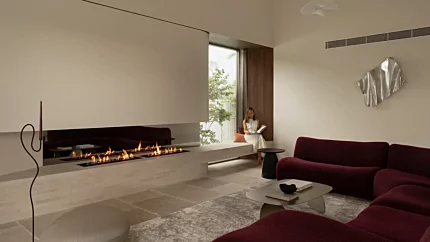 © Comma Projects and Alyne Media
 XL900 Ethanol Burner
Start with the room, not the burner.
When you think in terms of volume, enclosure, and viewing distance, ethanol burner size turns from guesswork into a straightforward decision. The coverage and minimum room figures published on every EcoSmart burner page are already doing most of the work; they just need to be read in the right order.
Here you will learn how to link those numbers to your own plans, distinguish between ambience-led and supplemental-heat briefs, and decide whether a compact round flame or a long linear line will earn its place on your wall.
Loading image...
© Comma Projects and Alyne Media XL900 Ethanol Burner
Sizing an EcoSmart ethanol burner is not a single calculation. It is the intersection of four inputs, each of which shifts the answer. Treat them as a checklist before you compare any models.
Room size and ceiling height. A 25 m² lounge with a 2.4 m ceiling is a very different brief from a 25 m² atrium with a 4.5 m void above it. Volume, not floor area, governs how the heat behaves.
Ambience or supplemental heat. A burner specified purely for atmosphere can be smaller than the room's stated coverage; a burner specified to take the chill off the evening needs to sit at the top of the recommended range.
Indoor, semi-covered, or open outdoor settings each shape the heat differently, and the certifications and clearances change with the environment.
A compact round flame reads as a focal point at close range, while a long linear flame reads across a wide wall or a media-wall opening, so format and viewing angle inform the sizing decision as much as the kW figure does.
Ethanol burner sizing rewards thinking about the four inputs in order rather than reaching for the largest unit that fits the budget. Ethanol burner for room size is a question of fit, not maximum output.
Floor area is the headline number, but the volume above it determines whether the burner's rated coverage holds. EcoSmart publishes a minimum room volume in cubic metres for every model alongside the average heated area in square metres. Use the volume figure as the indoor floor, and treat the heated-area figure as a guide for atmosphere rather than a guaranteed thermal lift.
EcoSmart appliances are designed as decorative and supplemental heat sources, real flame that holds a room's attention and takes the chill off an evening. They pair naturally with a building's primary heating system rather than replacing it. If the brief is whole-house heating, specify that separately and let the burner do what it does best, which is hold the room's attention.
The same burner will read smaller on an exposed terrace than it does in a fully enclosed lounge. Wind moves the flame, ambient temperature works against the radiant warmth, and the open volume above the burner is effectively limitless. Outdoor specifications usually call for a larger unit than the equivalent indoor brief.
A compact round burner suits a coffee-table-height hearth, a low dividing wall, or a circle of seating. A linear burner suits a long focal wall, a media-wall opening, or a freestanding fireplace where the flame reads from one side of the room to the other. Format is a design decision as much as a sizing one, and the comparison between round and linear is worth its own deliberation before you commit.
Loading image...
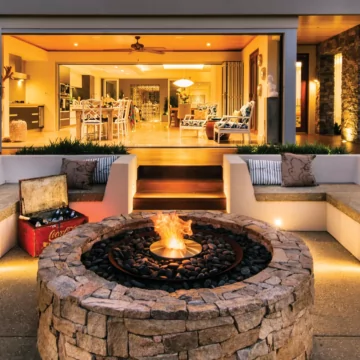
AB8 Ethanol Burner
Loading image...

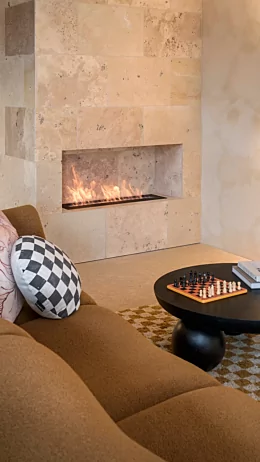
XL900 Ethanol Burner
Ethanol burners are rated in kilowatt (kW) or Megajoules per hour (MJ/h) of heat output, and indoor sizing starts with the minimum room volume the burner needs to operate safely. As a rough indoor starting point: small lounges and bedrooms (around 40 to 70 m³) match a 2 to 3 kW burner; mid-size open-plan rooms (70 to 110 m³) match a 4 kW burner; large rooms, voids, and double-height spaces (over 110 m³) match the top of the range at 6 kW.
Two ratings matter when you cross-check a product page. The first is the published heat output, which EcoSmart publishes as a BTU/hr figure and we present in kW alongside the BTU/hr on the product pages, since the kW conversion makes the comparison easier across markets. The second is the minimum room volume each burner needs to operate indoors. That second figure protects against undersizing the room relative to the burner, which is a different problem from undersizing the burner relative to the room. EcoSmart publishes both numbers for every model in the range, so the framework drops cleanly onto the spec table.
Tank capacity tells you how long the burner runs between refills. Heat output tells you how the room will feel while it is running. Two burners with the same tank size can carry very different outputs, and the larger output is the one that changes the experience. Our ethanol burners collection publishes both numbers for every model, but treat kW as the leading figure when sizing.
A US Department of Energy guideline authored by Arlan Burdick for the National Renewable Energy Laboratory confirms that residential heating calculations must account for floor area, ceiling height, building envelope, climate zone, and infiltration. The principle is the same for a decorative ethanol burner: a 3.5 m ceiling adds volume that a square-metre figure does not capture, and an open-plan layout that flows into a kitchen or a stair void effectively continues the room past its visible walls. When in doubt, sum the connected volumes and step one rung up the burner ladder.
Use the minimum room volume from the product page as a non-negotiable floor for indoor use. Then check the average heated coverage to make sure the burner reaches the seating area, not just the immediate hearth. If the room is borderline between two burners, choose the larger one when the brief is supplemental warmth and the smaller one when the brief is pure atmosphere.
Loading image...

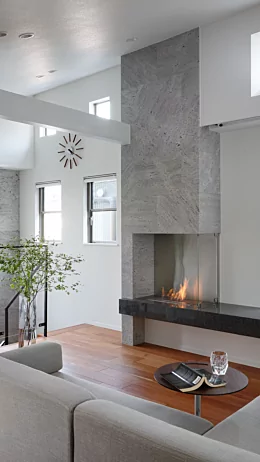
XL500 Ethanol Burner
Loading image...

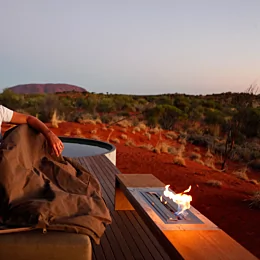 © Longitude 131° / Photo: Julian Kingma
 XL700 Ethanol Burner
Outdoor heat behaves differently. Radiant warmth dissipates faster, ambient temperature varies, and any breeze across the flame changes the effective output a guest will feel a metre away. There is no codified outdoor-to-indoor multiplier published by a standards body, but the practical implication is consistent: outdoor and semi-covered installations usually need a larger burner to deliver the same perceived warmth as an indoor brief.
The three scenarios sort cleanly.
Fully enclosed indoor room. Sized to the room's volume; minimum room size from the product page is the floor. Ventilation rules apply.
Semi-covered space (pergola, alfresco room, covered terrace). Treated closer to the outdoor side of the line; specify one rung up the ladder from the equivalent indoor brief.
Open outdoor area. Effective volume is unbounded; choose the largest burner the format and clearances will accept, and accept that the warmth will be felt close to the flame rather than across the whole space.
EcoSmart burners carry UL and EN 16647 certifications, and the installation manual for every model specifies the airflow requirement for the room you are placing the fire in. The UL guideline EcoSmart references is 5.7 m³ (200 ft³) of room air space per 1,000 BTU/hr of burner output, with a window open at least 25.4 mm if the room sits below that floor. A CO detector is good practice for any room with a combustion appliance, ethanol, gas, or candles, and pairing one with the fire is a simple addition to any installation. The Devon and Somerset Fire and Rescue Service makes the same general recommendation for any indoor combustion appliance.
A semi-covered space gives you the design benefits of an outdoor brief with a fraction of the heat loss. The roof traps radiant warmth, the side openings let combustion air move freely, and the flame is sheltered from gusts that would otherwise flicker the line. Step one rung up from the equivalent indoor specification and you will get a more consistent thermal read in autumn and early winter.
Open decks, courtyards, and rooftop terraces ask the burner to compete with the weather. The Equinox Hotel rooftop terrace in New York, documented by Dezeen's outdoor-fire lookbook, arranges seating tightly around the flame rather than across the whole terrace, which is the right design move for an open-air brief. Specify the largest burner the format and overhead clearance allow (2,000 mm overhead to combustibles outdoors), and design the seating layout around the radiant zone rather than the volumetric one.
Loading image...
XL500 Ethanol Burner
Format takes the sizing decision and gives it a shape. The compact round burners, the linear range, and the extra-large units each suit a different installation logic.
Format | Typical use | Typical space |
|---|---|---|
Compact round burner | Focal point at close range; small hearths, coffee-table-height plinths, low dividing walls | Bedrooms, snugs, intimate lounges, small courtyards |
Linear burner | Long flame across a wide focal wall, media-wall opening, freestanding fireplace | Open-plan lounges, dining rooms, pergolas, terraces |
Extra-large burner | Statement focal flame in a large or commercial volume | Atriums, double-height voids, hospitality lobbies, large outdoor courtyards |
Round versus linear is also a design decision. The shape changes how the flame is read from across the room, how the surround details resolve, and how the burner sits inside a broader hearth composition.
Compact round formats earn their place where the burner is meant to be felt at close range. Proctor & Shaw's Dulwich house extension, documented by Dezeen, builds a small bioethanol fire into the base of a short dividing wall between the dining and living areas. The flame anchors the lower band of the space rather than competing with the eye-level art. That is the brief a compact round burner pays off.
A linear flame reads across a wide wall the way a strip of light reads across a ceiling: a continuous horizontal line that draws the eye sideways. Within EcoSmart's XL series, width and depth are identical across all four models, only the length changes, so the design grammar is consistent whether the opening is 500 mm or 1,200 mm. That consistency lets the architectural detail resolve cleanly at every scale.
Hospitality and large-volume residential projects ask for a flame that holds the room from across it. The Say No Mo salon-lounge in Kiev, documented by Hospitality Design, suspends a bioethanol fireplace from the lounge ceiling as an ambient feature. That kind of brief sits at the top of the output range, where the flame is large enough to be the room's focal point and the heat is a secondary benefit rather than the primary justification.
Loading image...

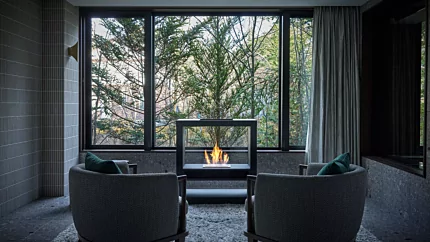 © FUFU Kyu-Karuizawa, Restful Forest
 XS340 Ethanol Burner
Work the five steps in order. Each step removes options from the shortlist; by the fifth, you will be looking at one or two burner ranges that suit the brief.
Measure the space. Floor area in square metres, ceiling height in metres, and connected volumes that open into the room. Record the total volume in cubic metres. A US DOE-sponsored heating guideline confirms that volume, not just area, is a required input in any heat-load calculation.
Decide ambience or supplemental heat. Ambience-led briefs sit comfortably in the middle of a burner's stated coverage; supplemental-warmth briefs sit at the top end. Either way, the burner is decorative or supplemental, never the room's primary heat source.
Confirm indoor, semi-covered, or open outdoor. Indoor sizes to volume; semi-covered steps one rung up; open outdoor takes the largest burner the format and clearances will accommodate.
Choose the flame line and viewing angle. A compact round flame for intimate hearths and dividing walls; a linear flame for wide focal walls and media-wall openings; an extra-large unit for atriums, voids, and commercial volumes.
Match to the EcoSmart burner range. The shortlist drops onto the rungs below.
Measure once, in metric. Note the ceiling height separately from the floor plan, and add any adjoining volumes that flow into the space without a door. The total cubic-metre figure is the number to carry forward.
If the room already has central heating, hydronic floors, or a heat-pump system, the burner is ambience. If the burner needs to register on a cool autumn evening in a glazed sunroom, it is supplemental. The brief decides the rung.
Indoor is the strictest brief, with a minimum room volume and a ventilation rule per UL guidance. Semi-covered and outdoor relax the volume constraint but introduce wind, ambient temperature, and overhead-clearance considerations. Almost every burner in the EcoSmart ethanol range carries the same indoor or outdoor application rating, with the single exception of the VB2 retrofit insert, which is designed for indoor masonry-chimney installations only.
The shape of the flame defines the architectural moment. A round flame in a low hearth reads as a campfire moved indoors; a long linear flame in an opening reads as a line of light. Tami Faulkner's design practice recommends allocating roughly one-third to one-half of the wall's height and width to the fireplace opening and surround. That proportion translates directly into a burner length that suits the wall.
The decision tree lands here. The ladder runs from compact round at the bottom to extra-large round at the top, with the linear XL range filling the middle. Each row carries an indoor minimum room volume, an average heated area, and a heat output expressed in both kW and BTU/hr.
Burner | kW | BTU/hr | Avg area | Min indoor room | Format |
|---|---|---|---|---|---|
AB3 | 2 kW | 5,800 BTU/hr | 20 m² [215 ft²] | 40 m³ | Compact round, indoor or outdoor |
XS340 | 2 kW | 8,530 BTU/hr | 20 m² [215 ft²] | 45 m³ | Compact linear, indoor or outdoor |
XL500 | 3 kW | 11,430 BTU/hr | 40 m² [431 ft²] | 80 m³ | Linear, indoor or outdoor |
BK5 | 4 kW | 13,000 BTU/hr | 35 m² [377 ft²] | 70 m³ | Mid round, indoor or outdoor (Design Mark, 2004) |
XL700 | 4 kW | 13,650 BTU/hr | 50 m² [538 ft²] | 90 m³ | Linear, indoor or outdoor |
XL900 | 4 kW | 15,000 BTU/hr | 60 m² [646 ft²] | 110 m³ | Linear, indoor or outdoor (most popular XL) |
XL1200 | 4 kW | 15,290 BTU/hr | 65 m² [700 ft²] | 115 m³ | Linear, indoor or outdoor (Vesta Award, 2009) |
AB8 | 6 kW | 20,433 BTU/hr | 60 m² [646 ft²] | 116 m³ | Large round, indoor or outdoor |
The VB2 retrofit insert sits outside this ladder. It is rated 2 kW (6,180 BTU/hr) for 15 m² coverage and 45 m³ minimum room volume, designed specifically for indoor masonry-fireplace retrofits, and not covered by the same UL 1370-16 and EN 16647 listing that applies to the rest of the range.
Undersizing the flame in a large room. A 2 kW burner in a 120 m³ open-plan lounge reads as a candle on a dining table. Step up the ladder until the flame holds the volume.
Oversizing in a small room. A 6 kW burner in a 50 m³ snug pushes the room past the minimum volume the burner needs to operate. The result is a hot, under-ventilated space and a flame that overwhelms the seating.
Choosing on tank capacity alone. A 9 L tank does not make a burner suitable for a larger room. It makes the burner run longer between refills. Heat output and minimum room volume are the sizing numbers.
Treating outdoor spaces like indoor rooms. An outdoor courtyard does not behave like a lounge with the windows open. Heat moves differently, the radiant zone collapses faster, and the unit usually needs to step up a rung from the equivalent indoor brief.
Ignoring ceiling height. A 3.5 m ceiling adds volume that a floor-plan figure misses. A double-height void or a connected stair landing extends the room past its visible walls. Calculate cubic metres before you specify.
Round and linear burners read differently in the same room volume even at identical kW, because the flame's shape changes how the heat and the light are distributed. That is partly a sizing question and partly a design one.
A 50 m² room with a standard 2.4 m ceiling is roughly 120 m³. For supplemental warmth, a 4 kW burner with a minimum room volume below 120 m³ is the appropriate rung. If the room is open to an adjoining space, sum the connected volumes and step up to the 6 kW class.
Heat output. Burn time tells you how often you will refuel; heat output tells you whether the burner will perform in the space. Two burners with identical 9 L tanks can carry very different kW ratings, and the kW figure is the one that changes the experience of the room.
EcoSmart ethanol appliances are designed as decorative and supplemental heat sources, real flame that holds a room's attention and takes the chill off an evening. For whole-house heating, pair the burner with the building's primary system and let the fire do what it does best.
Yes, and EcoSmart's ventilation guideline is straightforward: 5.7 m³ of room air space per 1,000 BTU/hr of burner output. Most rooms clear this easily; a standard 40 m³ lounge handles the AB3's 2 kW output with room to spare. In a smaller space, a partially open window or an adjoining door satisfies the requirement, and the full clearance and ventilation spec ships with every model.
Most models in the range carry an indoor or outdoor application rating, which means the same unit can be specified for either environment. The exception is the VB2 retrofit insert, which is designed for indoor masonry-chimney installations only and is not covered by the same UL and EN listings as the rest of the range.
Yes. Heat-load methodology calls for room volume, not floor area, as the input. A 3.5 m ceiling adds roughly 45% more volume than a 2.4 m ceiling for the same floor plan, and that volume should push the specification one rung up the ladder.
Sizing an ethanol burner well is a conversation between the room and the flame. The four inputs at the top of this article (volume, role, environment, format) are the conversation's vocabulary; the five-step decision tree is the way you walk it through to a shortlist. The output is a burner that suits the wall it sits on, the room it warms, and the way people will move through the space when the flame is lit.
What separates a well-sized installation from a forgettable one is rarely the kW figure. It is the proportion of the flame to the wall, the relationship between the radiant zone and the seating, and the way the format resolves the architectural detail around it. EcoSmart's range gives you a clear progression from compact round to extra-large round, with the linear XL series filling the middle and the same indoor or outdoor rating across almost every step. Two decades of burner engineering, two named design awards, and a quarter of a million installations sit behind that progression. The right unit is the one where the brief, the room, and the rung line up.
Specify with the volume in mind, the role in mind, and the wall in mind. The burner will do the rest.